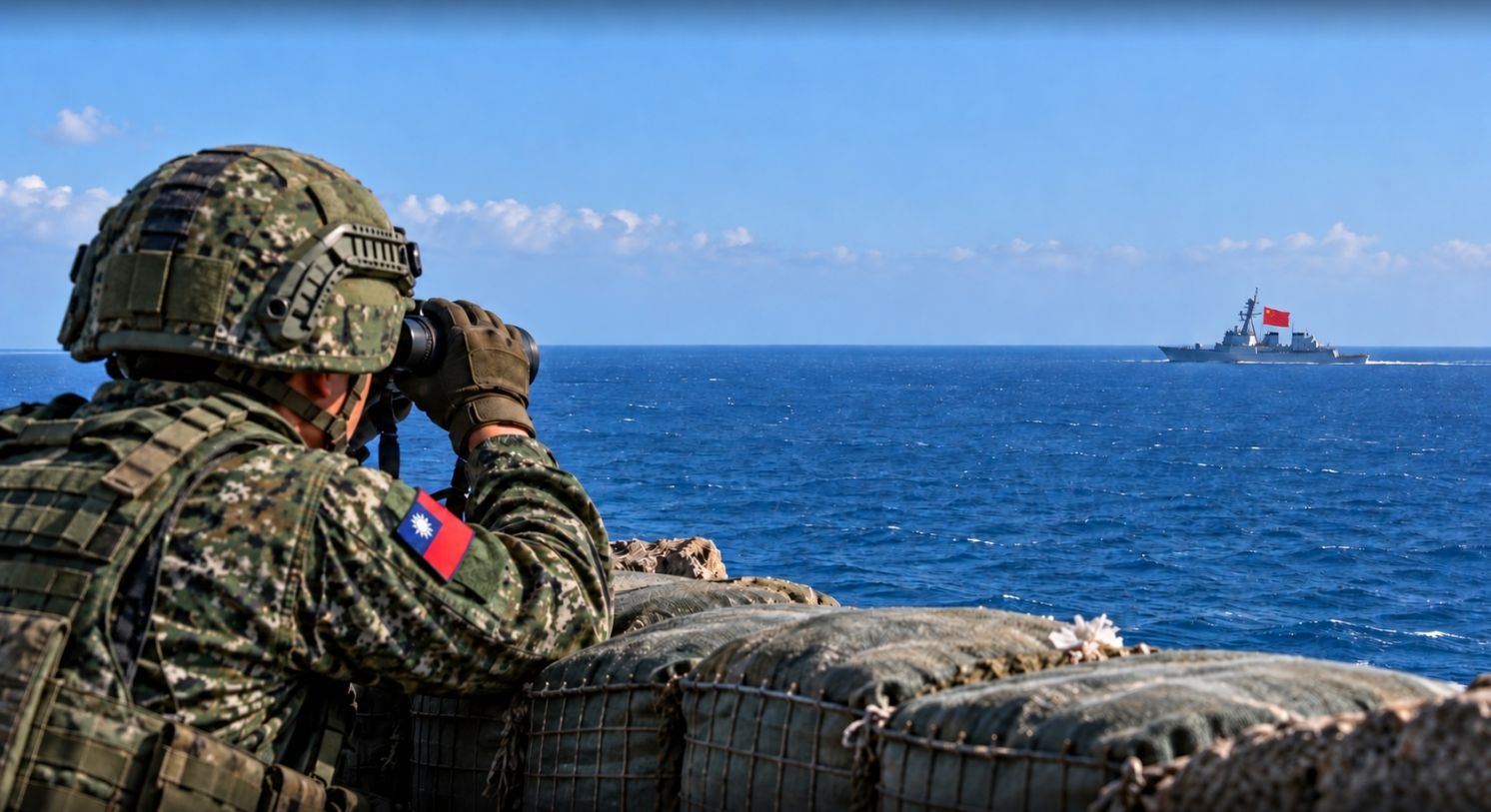
U.S. Marine Corps Shifts to Defensive Posture: Taiwan Must Resist PLA on its Own
United Daily News Report, October 12, 2026
An article published in The National Interest reported that the U.S. military plans to deploy anti-ship and air defense missile systems on Yonaguni Island. According to Taiwanese experts, the move is part of the U.S. Marine Corps' transformation, shifting its focus from amphibious landing operations to defensive firepower aimed at slowing large-scale breakthroughs by China's People's Liberation Army (PLA) beyond the First Island Chain. This also means that, should war break out across the Taiwan Strait, Taiwan would have to withstand PLA attacks on its own for a prolonged period. In the initial stages of a conflict, American assistance would likely be limited to intelligence support and long-range strikes. The main U.S. forces would not approach the Taiwan Strait until the PLA had been substantially weakened.
Shih Hsiao-wei, editor-in-chief of the website Military and Aviation News, said the Marine Littoral Regiment (MLR) has become a hallmark of the U.S. Marine Corps' transformation in recent years, marking a shift from heavily equipped strike forces to rapid-response raiding units. Since 2022, three infantry regiments have been reorganized into Marine Littoral Regiments, stationed in Hawaii, the Ryukyu Islands, and Guam, respectively. These regiments do not have artillery or tanks but are equipped with large numbers of anti-ship missiles, supplemented by air defense missiles, perimeter security personnel, and support forces. Each regiment consists of nearly 2,000 personnel, roughly half the size of a traditional infantry regiment.
According to Shih, Marine Littoral Regiments are not designed to conduct amphibious operations against enemy territory. Instead, they capitalize on their ability to deploy and withdraw rapidly, allowing them to occupy islands along the First Island Chain when necessary and transform them into firepower strongholds. From these positions, they can deny enemy access to surrounding waters and airspace, preventing or slowing attempts to breach the island chain.
Chieh Chung, associate research fellow at the Institute for National Defense and Security Research, said the establishment of Marine Littoral Regiments reflects a shift in U.S. military strategy in the Western Pacific. Because the PLA possesses formidable strike capabilities within and around the First Island Chain, U.S. forces cannot afford to approach the area lightly. Instead, the main U.S. forces must initially remain positioned along the Second Island Chain, leaving only smaller units, such as Marine Littoral Regiments, within the First Island Chain to obstruct and delay PLA attempts to break through. In other words, Washington hopes to achieve control over maritime areas with a relatively small number of troops.
Chieh stated that if war broke out across the Taiwan Strait, even if the United States were willing to provide support, it would be impossible to repeat the situation seen during the 1996 Taiwan Strait Crisis, when U.S. aircraft carriers sailed directly into waters near Taiwan. Taiwan would inevitably have to sustain its defense independently for a considerable period, including conducting ground combat operations. He noted that this was precisely the rationale behind Defense Minister Wellington Koo's earlier statement that Taiwan should increase its stockpiles of military readiness supplies to cover 120 days.
According to Chieh, U.S. support in the early stages of a war might be limited to intelligence sharing and long-range firepower strikes. Washington might establish a secure maritime and airspace zone, but such a zone would not extend to Taiwan's doorstep. Only when the United States determines that PLA forces have been sufficiently depleted would the main U.S. forces begin advancing westward.