U.S.-Japan Joint Military Exercises Undermine Notion of "Taiwan Contingency"
United Daily News Commentary, October 28, 2026
A nationwide survey released by Japan's Public Interest News Foundation found that although nearly 70 percent of Japanese support explicitly recognizing the Self-Defense Forces in the Constitution, as many as 80 percent oppose deploying troops to provide support in the event of a "Taiwan contingency." Meanwhile, the proportion of respondents who view the United States as a "threat to world peace" has risen sharply, reflecting deep concerns among the Japanese public about global instability. Only 9.9 percent support "coordinating with U.S. forces," demonstrating the Japanese public's strong desire to avoid becoming involved in armed conflicts abroad.
This indicates that although the Japanese people are friendly towards Taiwan, the majority remain unwilling to become involved when confronted with the reality of war. Evidently, Prime Minister Sanae Takaichi's attempt late last year to revive the "Taiwan contingency" narrative to bolster the U.S.-Japan alliance has, nearly a year later, been rejected by Japanese public opinion with the message that "it is none of our business."
Coincidentally, another question that has long concerned the Taiwanese public—"Would Japan send troops to assist Taiwan in the event of a cross-strait conflict?"—was addressed at almost the same time by Katsuya Yamamoto, a former rear admiral of the Japan Maritime Self-Defense Force. Mr. Yamamoto explicitly stated that "under Japan's current legal restrictions and given the Self-Defense Forces' priority of defending Japanese territory, it would be practically difficult for the Self-Defense Forces to participate directly in Taiwan's defense or evacuation operations." Yamamoto has studied at the United States Coast Guard Academy, Japan's National Institute for Defense Studies, and the National Defense University of the People's Liberation Army (PLA). He also served as defense attaché and naval attaché in Beijing, as well as head of the naval attachés' association.
In Japan's military research community, traditionally known for its rigorous academic standards, Mr. Yamamoto's remarks effectively refute Takaichi's political statements on the Taiwan Strait from a military perspective.
As for Mr. Yamamoto's characterization of Taiwan's Armed Forces as an objectively existing "military entity," his position has nothing to do with determining political sovereignty, nor does it imply recognition of Taiwan independence. Rather, it is based on practical security considerations aimed at preventing Japan from becoming involved in a military conflict, making it a typical argument grounded in geopolitical realism.
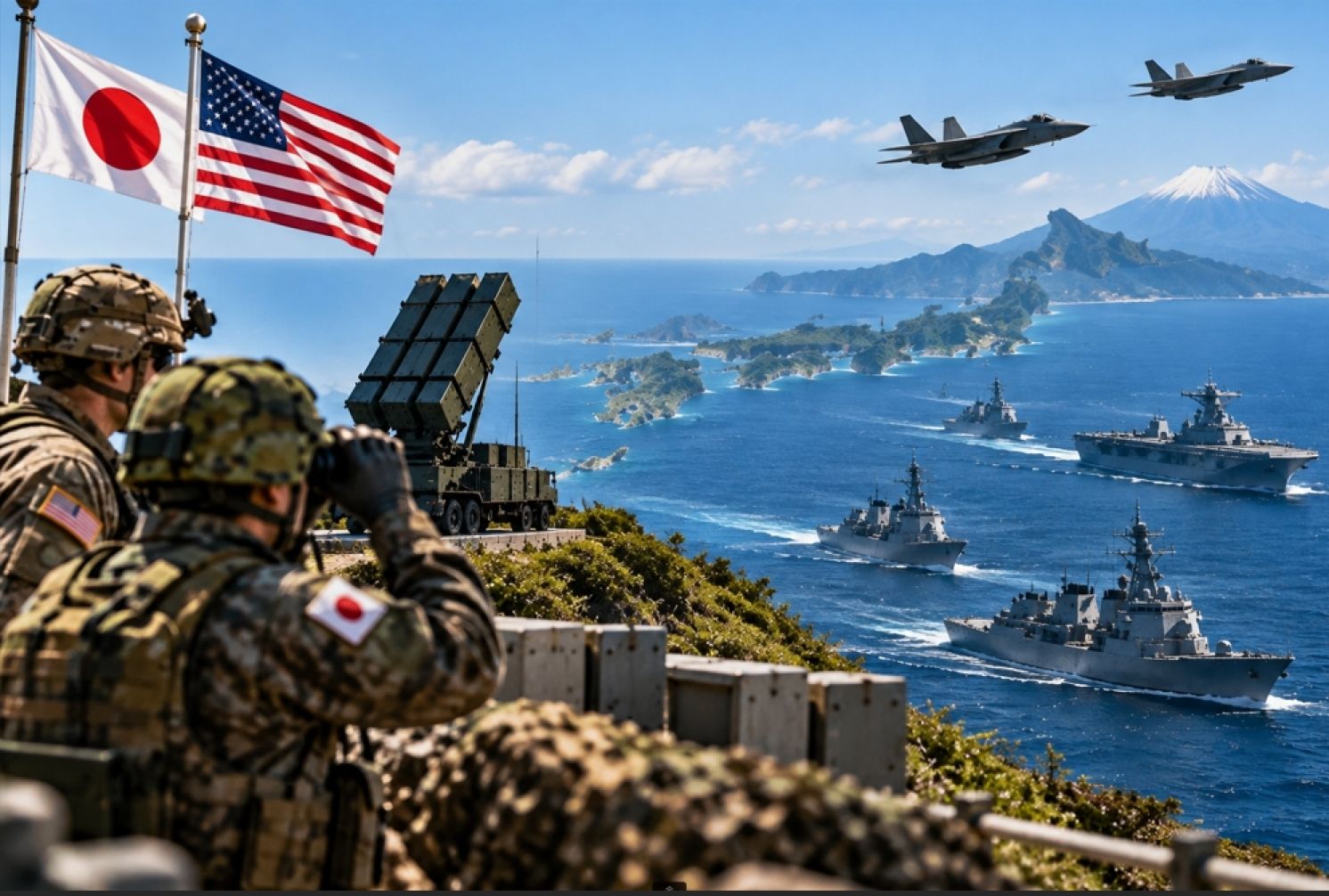
In another coincidence, the scale and nature of deployments during the U.S.-Japan "Keen Sword" joint military exercise, held from October 19 to 29, also align with the aforementioned statements. For the first time, the U.S. Marine Corps deployed the new land-based anti-ship missile system known as the Navy/Marine Expeditionary Ship Interdiction System (NMESIS), along with the Marine Air Defense Integrated System (MADIS), on Yonaguni Island.
What the U.S. military deployment truly seeks to demonstrate is a strategic red line defined by Yonaguni Island. This deployment concept originated from the "dynamic force employment" approach introduced in 2020, which shifted toward positioning small, mobile missile units on islands throughout the Pacific to deter enemy warships operating in surrounding waters.
Yonaguni Island is the Japanese territory closest to Taiwan, located just 111 kilometers in a straight line from Taiwan's eastern coast. Its surrounding waters and airspace are highly congested. For many years, patrol areas of military and law enforcement aircraft and vessels from neighboring countries have frequently overlapped. U.S. naval and air units stationed in Northeast Asia must also pass through this region when traveling to Southeast Asia and Australia for various exercises and training activities. As early as the summer of 2016, Japan deployed long-range radar and surveillance facilities on the island. At the same time, the PLA increased its activities in the surrounding waters, strengthening its maritime and aerial patrols in the region.
Under the U.S.-Japan Security Treaty, Japan's "Far East" region includes the economic waters adjacent to Taiwan. If the U.S. military intervenes in a cross-strait conflict, then it would inevitably use its "forward bases" in Japan. The United States maintains that if China launches attacks against U.S. military bases in Japan to prevent U.S. intervention, such attacks would be directly regarded as aggression against Japanese territory. However, this is essentially a preventive argument that reverses cause and effect. Since early August 2022, when then-Speaker Nancy Pelosi of the U.S. House of Representatives visited Taiwan and the PLA Rocket Force demonstrated its area-denial capabilities by launching short-range missiles into waters east of Taiwan near Japan's maritime boundaries, the so-called U.S.-Japan alliance defense network has, in practice, no longer been able to incorporate a Taiwan-related component.