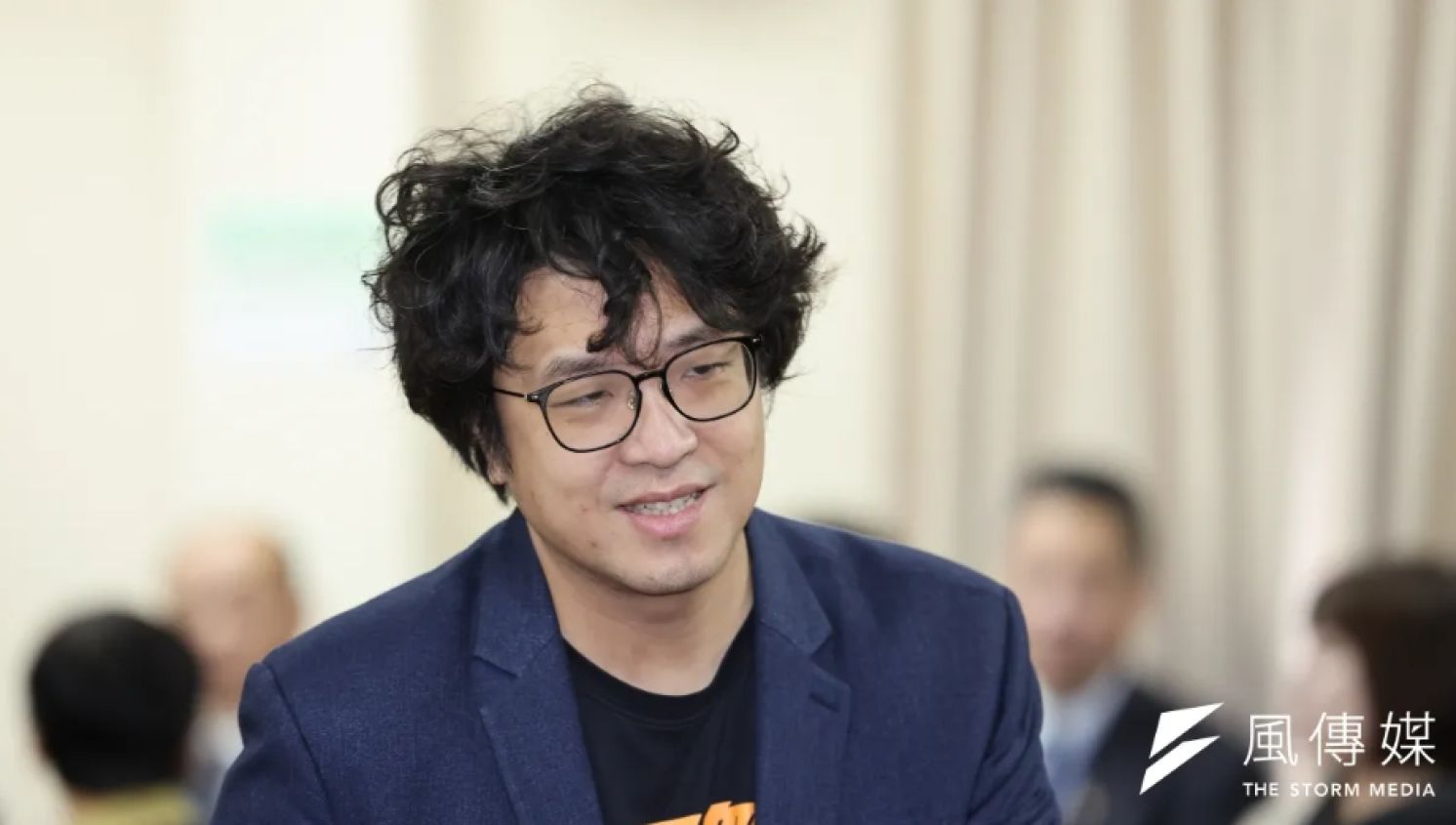
Three Political Transformations: Who is the Real Shen?
By Li Wo-teng, The Storm Media Opinion, October 21, 2026
Looking back at Democratic Progressive Party (DPP) Taipei mayoral candidate Shen Po-yang’s public image over the years and compiling it into a single collection inevitably raises a question: Is this the “real Shen” we are seeing now, or a “Shen who has been manufactured”?
Since Mr. Shen began actively participating in public discussions in 2014, his public persona can be clearly divided into three phases. The first phase, from 2014 to 2019, was that of a progressive leftist. At the time, he was a doctoral student in criminology and later became an assistant professor. He advocated decriminalizing drugs and providing drug users with drugs and clean needles at community centers, among other measures. He supported legalizing marijuana and was “more inclined toward the abolitionist position on the death penalty.” He also argued that the constitutional system of the Republic of China was a “quasi-colonial system.”
The second phase, from 2019 to 2025, was that of a radical right-winger. Around 2018, he founded the Taiwan Democracy Lab, focusing primarily on research into China’s cognitive warfare and infiltration. If the premise that “China is the target” is removed from his arguments, his positions—including strengthening border controls, labeling specific groups, classifying groups by risk, expanding surveillance, and tightening loyalty screenings—would be categorized as right-wing, or even “radical right-wing,” on the political spectrum of any Western country.
In the third phase, beginning in 2026 after he entered the election, he became a “moderate, pragmatic, and warm-hearted man,” shifting once again from the “radical right” to the moderate center. The extent of Mr. Shen’s transformation over such a short period inevitably raises questions. If the person we see in 2026 is the “original” Shen, then what was the Shen who stood on the front lines of “resist China to protect Taiwan” from 2019 to 2025 and charged ahead during the mass recall campaign? Was that a manufactured persona?
Many voters may consider the drug issue merely a matter of political sparring. But the ultimate question may be whether this is a person worthy of trust. Mr. Shen’s handling of the criticism has hardly been satisfactory.
On drugs, which he has framed as a matter of “cognitive warfare,” Mr. Shen initially insisted that “what I said back then is exactly what Taipei is doing now with methadone treatment.” Yet anyone who carefully reads the original text would reach the opposite conclusion. On the death penalty, Shen has claimed that the title of a book review he authored is “misleading,” and the purpose was to “trick people who support the death penalty into buying and reading it.”
On the issue of mainland Chinese spouses, Mr. Shen emphasized that he had never accused mainland spouses of being people who “need to be monitored or surveilled.” Yet he repeatedly referred to a “high-risk group” and “hundreds of thousands of people”—figures that correspond only to the population of mainland spouses.
Take the mass recall campaign, for example. Mr. Shen was once an enthusiastic supporter and a leading figure in the campaign, but now he appears to be distancing himself from all responsibility. In short, when it comes to explaining how he transformed from a right-winger into a “moderate, pragmatic, and warm-hearted man,” all we see is an attempt to disavow responsibility.
Recently, Hong Kong media reported that after Mr. Shen’s father was sanctioned by China, he changed his company’s name and continued doing business with Chinese companies. Hong Kong and mainland Chinese media characterized this as “making money from the red market.” China subsequently added Shen’s father’s newly named company to its sanctions list as well.
In response, Mr. Shen asked, “Why was this reported at this particular time?” He also emphasized that the issue was “old news being recycled,” even though the report actually concerned new developments. Yet he refused to answer a straightforward question: Did his father change the company’s name and continue trading with Chinese companies? Shen has characterized cross-strait economic and trade ties as a “fifth column” and claims that “all exchanges are part of united front work.” Yet his own family is engaged in precisely this kind of activity. He has never answered the question directly.
Mr. Shen’s ability to construct arguments, his online visibility, and mobilization capacity have all been among the strongest of any DPP figure in Taipei in recent years. However, judging from the political exchanges over the past month or so, the emergence of so many controversies raises concerns that the scrutiny conducted before his nomination may have been insufficient. When a person has presented three different public personas over 12 years, the question of “which one is the real him” must ultimately be answered.