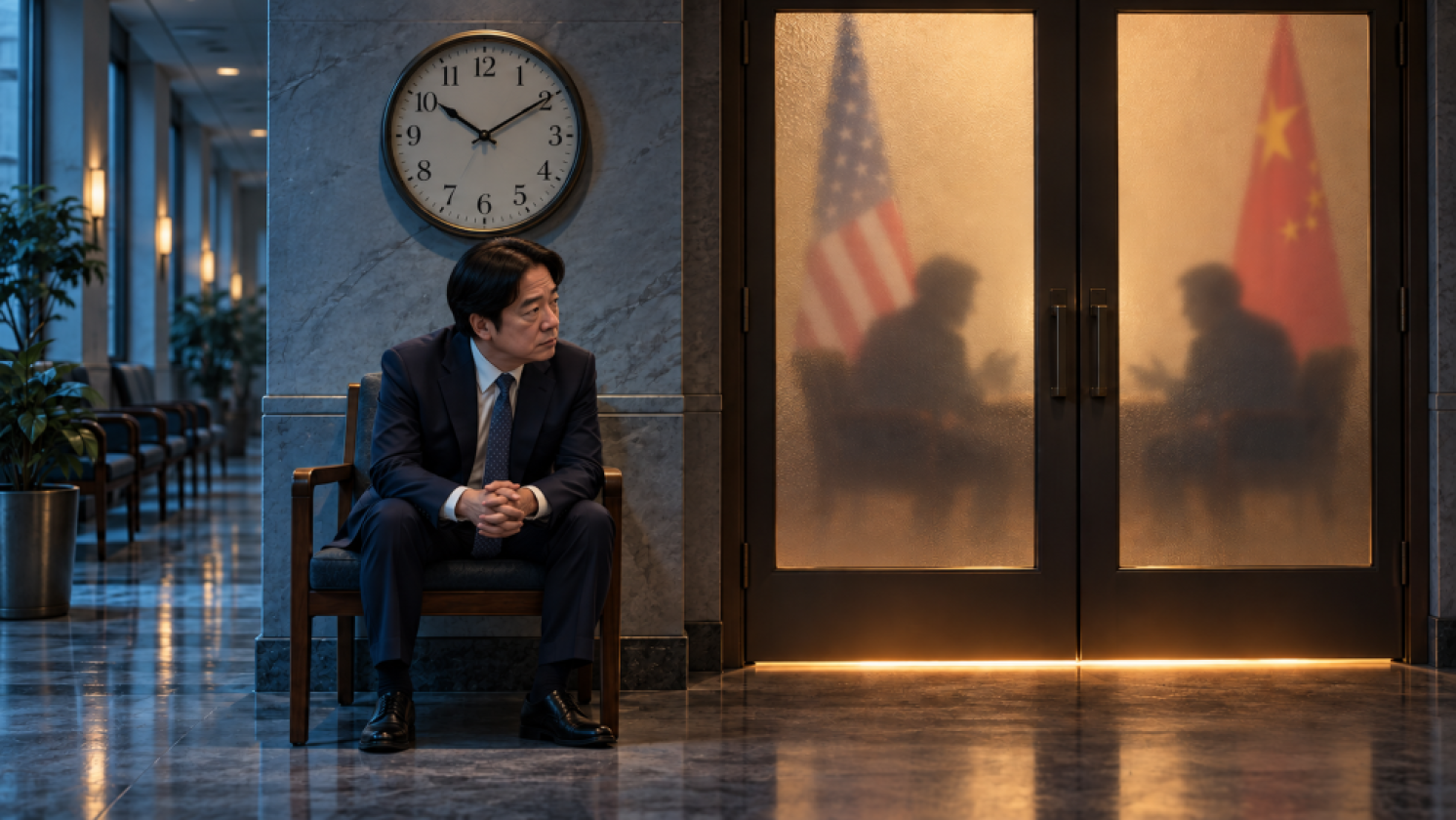
Taiwan Not Written into the U.S.–China Joint Statement
By Lee Hsiang-chou, United Daily News Opinion, September 28, 2026
The summit between President Donald Trump of the United States and Chinese President Xi Jinping at the White House concluded as scheduled. Together with the Beijing summit in May, two summits have now taken place. Taiwan was not written into any document, yet it appeared on every agenda. In my view, “This is not security. This is waiting—waiting to be arranged.”
To start with something rarely mentioned, on January 5, 1950, then-President Harry Truman issued a statement declaring that the United States had no intention of acquiring special rights or establishing military bases in Taiwan, nor would it intervene in the Chinese Civil War. The Acheson defense perimeter was subsequently drawn from the Aleutian Islands through Japan and the Ryukyu Islands to the Philippines, with Taiwan outside that perimeter. What changed all of this was neither any promise nor any lobbying effort, but the outbreak of the Korean War, after which Truman ordered the Seventh Fleet into the Taiwan Strait.
Taiwan’s first security guarantee came from a war that had nothing to do with Taiwan. This is one of the most fundamental yet rarely acknowledged historical facts necessary to understand Taiwan’s situation: Taiwan’s security has never historically been something promised by others, but rather something that came incidentally as a result of others’ needs.
We are accustomed to viewing the United States as Taiwan’s protector and Beijing as its threat. But history is more complicated. After the 1958 Taiwan Strait Crisis, Secretary of State John Foster Dulles visited Taiwan and issued a joint communiqué in which the Republic of China publicly declared that “the principal means of restoring freedom to the people on the mainland is through the implementation of the Three Principles of the People, not through the use of force.” This was not an autonomous decision by Taipei, but the result of pressure from Washington. The United States feared being drawn into an all-out war against mainland China and used the communiqué to place restraints on Taipei’s military options.
The 1972 Shanghai Communiqué was a public document, but what truly determined Taiwan’s fate lay in what was not made public: five principles discussed privately between Richard Nixon and Zhou Enlai—there is only one China, and Taiwan is part of China; the United States does not support Taiwan independence; the United States would prevent Japan from moving into Taiwan; it supports any peaceful resolution; and it would seek normalization of relations.
Not one of these five points was written into the Shanghai Communiqué. The real concessions took place in a room with no records available for Taipei to review.
This is another structural reality of Taiwan’s situation: what Taiwan should truly worry about is not what is written in documents, but the subjects that are not written down yet have already been discussed. At the White House summit in September, Chinese state media said Xi Jinping hoped the United States would “oppose” Taiwan independence, while the White House did not release any record of that exchange at the time.
On December 15, 1978, the United States announced the establishment of diplomatic relations with the People’s Republic of China and the severing of diplomatic relations with the Republic of China. But what happened next provides one of the most important lessons in Taiwan’s history.
The draft legislation submitted to Congress by Jimmy Carter’s administration did not address Taiwan’s security at all. Congress was outraged and thoroughly rewrote the administration’s draft, adding obligations regarding the provision of defensive arms, a clause expressing grave concern over the use of “non-peaceful means,” and a mechanism for mandatory congressional oversight. The Taiwan Relations Act passed both the House and Senate by overwhelming margins, forcing Carter to sign it into law. The most important security guarantee in Taiwan’s history was not given by a U.S. president; it was wrested from the president by the Congress.
Why this matters today is that any change in wording at a U.S.-China summit would raise questions about Washington’s resolve to defend Taiwan and provoke a backlash in Congress. Every major turning point Taiwan has experienced has followed a common pattern: the U.S. executive branch makes a decision, Taiwan learns about it afterward, and changes in the Congress, public opinion, or the international situation subsequently provide some degree of compensation.
The only way to break this cycle of waiting is to make Taiwan a variable that others must arrange to include, rather than arrange to remove.
The author is former director-general of the National Security Bureau.