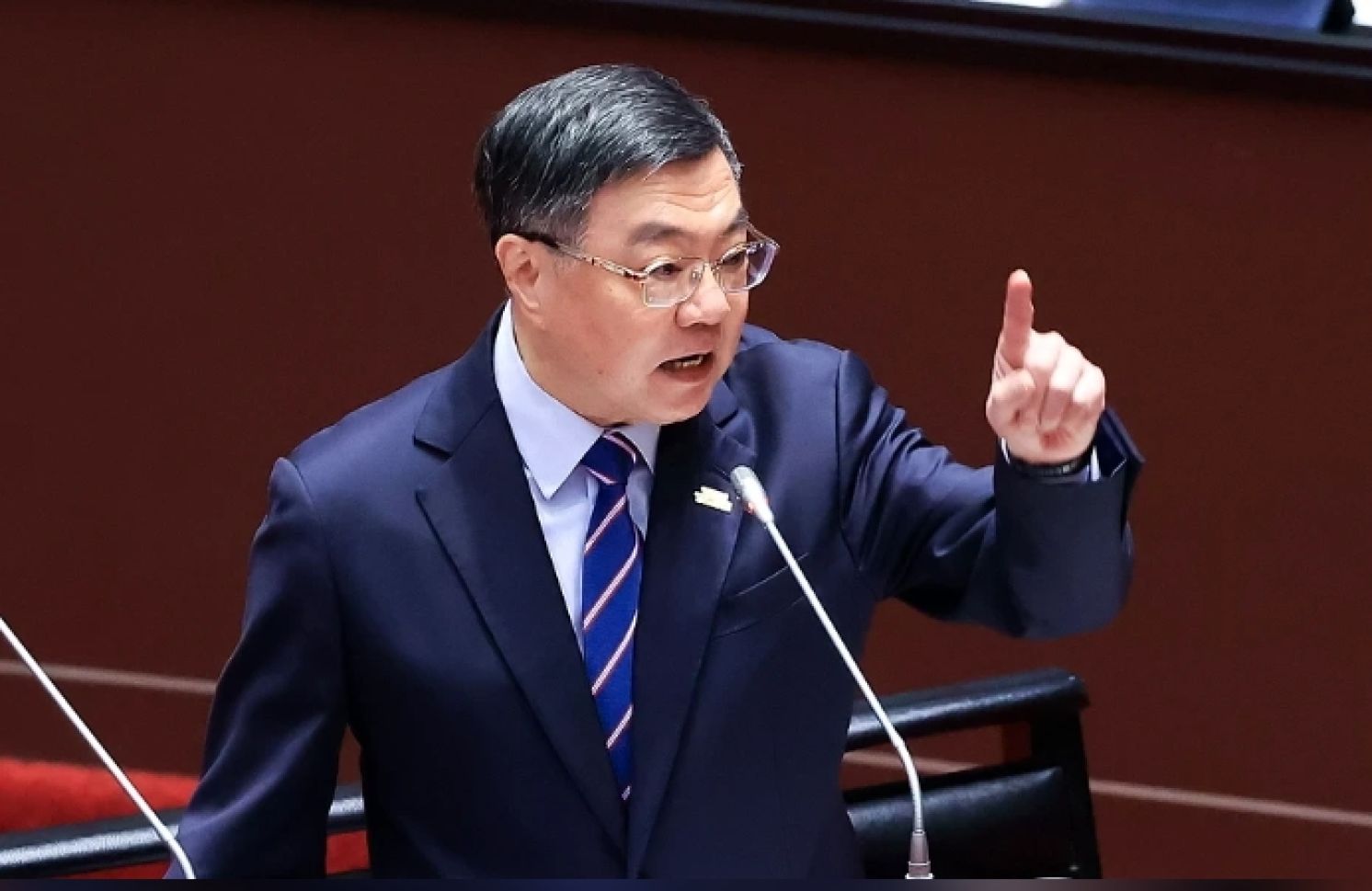
Premier Cho Weaponizes No Countersign Power, Creating Self-Styled Veto Power
United Daily News Editorial, August 21, 2026
The Legislative Yuan has passed the central government’s general budget, yet Premier Cho Jung-tai broke with constitutional convention by neither appearing before the legislature to express his appreciation nor offering thanks. More than that, he once again refused to countersign two pieces of legislation, including a law establishing future accounts for children and young people, effectively blocking them. He also lashed out at Speaker Han Kuo-yu of the Legislative Yuan, with President Lai Ching-te joining the fray. The arrogance of the Lai-Cho administration and its trampling of democratic constitutional norms are unprecedented.
Although the budget review this year was delayed by nearly eight months, the final outcome shows that the Legislative Yuan cut only NT$48 billion (about US$1.5 billion) from a total budget exceeding NT$3 trillion (about US$93.1 billion), or just 1.69 percent. Compared with the previous year, when some NT$200 billion (about US$6.2 billion), or 6.62 percent, was cut, this year’s reductions were relatively modest. The percentage is also not far removed from the levels seen under President Tsai Ing-wen from 2016 to 2024. The budget granted to the Cho cabinet is already close to the treatment accorded a government enjoying unified control of both the executive and legislative branches. The Lai administration’s complaints are therefore little more than political posturing.
To resolve the prolonged budget impasse, the opposition parties repeatedly made concessions. The Kuomintang (KMT) and Taiwan People’s Party (TPP) originally proposed some 1,700 motions to freeze or cut spending, but in the end only 36 required a vote. Even the highly controversial drone budget was approved in full without a single dollar being cut. Seen in this light, the opposition went beyond mere “compromise and concession” and came close to simply giving the government what it wanted.
Yet the Lai administration showed no appreciation and instead pressed its advantage. Even more bafflingly, Premier Cho repeated what he had done the previous year: After the government’s general budget passed its third reading, he refused to follow convention by visiting the Legislative Yuan to express his appreciation or acknowledge lawmakers from both the ruling and opposition camps. Under Taiwan’s constitutional system, the Legislative Yuan exercises budgetary oversight and review on behalf of the people. Even if the premier is dissatisfied with the outcome, such a gesture demonstrates respect for the democratic constitutional system. Premier Cho, however, has arrogantly invented his own constitutional convention, seemingly for no purpose other than to prolong political confrontation.
The passage of the general budget should have provided an opportunity for reconciliation between the executive and legislative branches. Speaker Han offered a goodwill suggestion that the Executive Yuan stop “refusing to countersign and refusing to implement laws.” Instead, the Lai administration immediately announced that it would not countersign the Children and Youth Future Account Act or amendments to the Radio and Television Act.
At this point, as many as seven bills passed by the Legislative Yuan after their third readings have been put on hold because the Executive Yuan refused to countersign them. Who gave the Executive Yuan such an “absolute veto power” over legislation? The danger of democratic regression and authoritarianism is now imminent.
The impetus behind this constitutional regression is the distorted political duet between President Lai and Premier Cho. Article 37 of the Constitution stipulates that laws promulgated by the president must be countersigned by the premier. The purpose is to ensure that the executive branch assumes responsibility for implementing them. The Lai administration, however, has turned this principle on its head, treating the power of countersignature as a shield allowing the president to avoid promulgating laws. President Lai even sent Speaker Han a written note stating that the legislation would not be promulgated because the Executive Yuan has declined to countersign it.
Does this not amount to President Lai reducing himself to a subordinate of Premier Cho, unable to act without the premier’s approval? Through their own political maneuvering, the Lai-Cho administration has reduced the Constitution to a farce. It is a disgrace to democracy.
By disregarding public opinion and democratic principles, Premier Cho is ultimately humiliating himself. The countersignature requirement was originally designed to check presidential power, yet President Lai has turned the refusal to countersign into a political shield. In doing so, he has taken this self-inflicted humiliation to an extreme.
Ultimately, the Lai-Cho administration does not care whether its budgets or legislation actually benefit the people. What concerns them above all is how to expand their own power and claim political benefits for themselves.