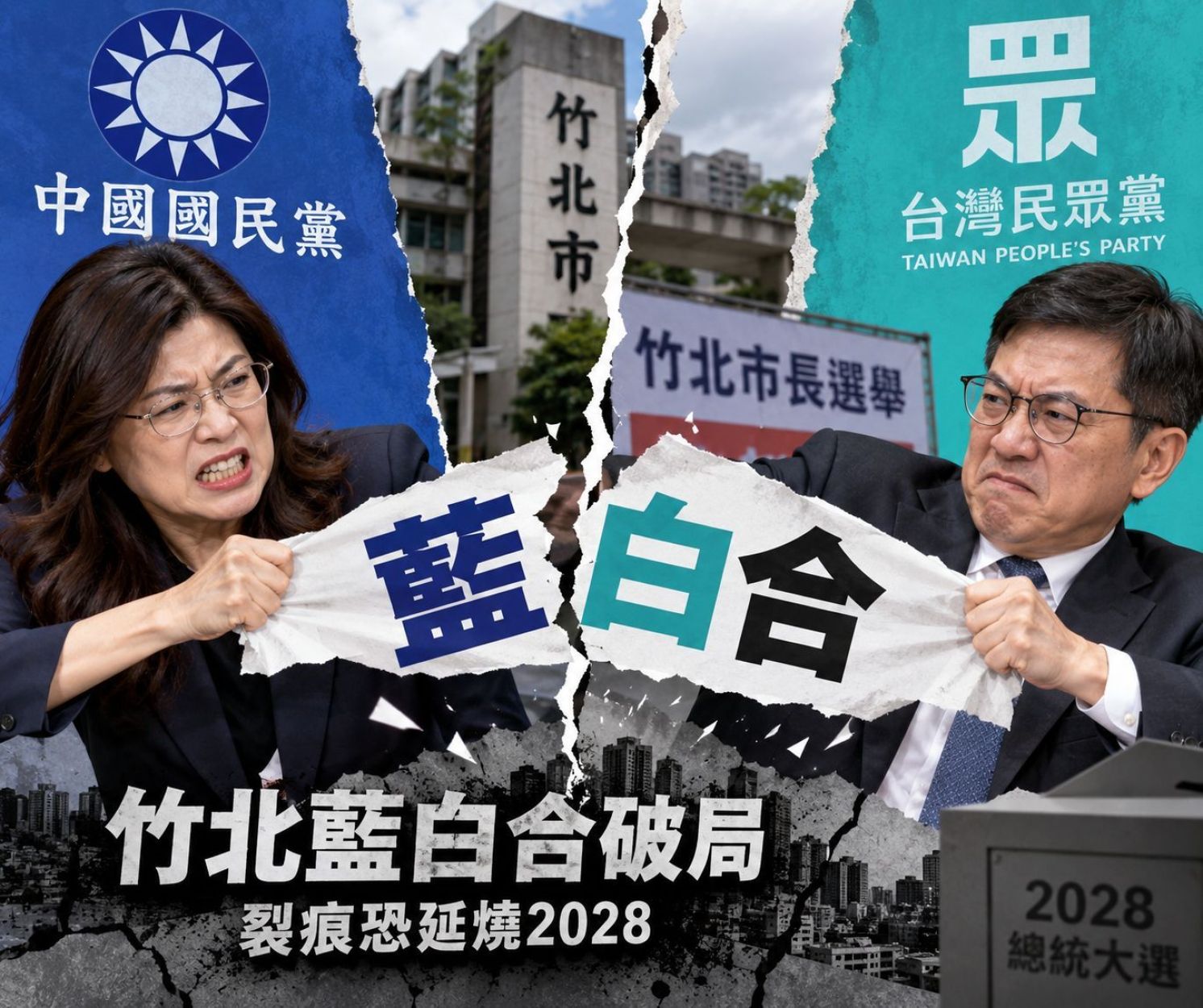
KMT-TPP Local Divisions May Trigger Domino Effect
United Daily News Commentary, August 30, 2026
The collapse of the opposition alliance between the Kuomintang (KMT) and Taiwan People’s Party (TPP) over the mayoral election in Zhubei City, Hsinchu County, is no longer merely a dispute over the nomination in a single constituency. It has become a serious test of the opposition camp’s foundation of mutual trust and strategic planning. If the two parties continue to avoid the core issue and lack a credible and effective coordination mechanism, the negative effects could continue to expand, ultimately allowing the ruling Democratic Progressive Party (DPP) to reap the benefits.
The key to the Zhubei breakdown lies not only in “who should make concessions,” but also in whether the tacit understanding or commitments between the two parties can be mutually honored. The TPP maintains that the two parties had reached a consensus that the KMT’s candidate should be supported in the Hsinchu County magistral election, while the Zhubei mayoral candidate should be recruited by the TPP, meaning that Chiu Chen-yuan, a former legislator and former deputy mayor of Hsinchu, would run. However, in response to KMT Hsinchu County Councilor Wu Hsu-chih registering to seek the nomination, KMT Chairwoman Cheng Li-wun said that the Zhubei race has highly distinctive characteristics, and that local groundwork, the structure of public opinion, and the overall strategic layout all require careful consideration. Therefore, the two sides have different assessments regarding the candidate arrangement.
The KMT has also emphasized that KMT-TPP cooperation on nominations mainly applies to county and city magistral elections, and that Zhubei was not formally included within the scope of the agreement between the two parties. Nevertheless, this dispute has precisely exposed the shortcomings of the two parties’ cooperation mechanism. After all, if the opposition camp cannot achieve integration and instead develops friction over the Zhubei nomination, it could not only alter the local electoral landscape but also undermine broader cooperation. If the race ultimately becomes a three-way contest among the KMT, TPP, and DPP, opposition votes would be divided, undoubtedly increasing the DPP’s chances of victory.
More importantly, if the Zhubei mayoral election is overturned due to a Blue-White split, the impact may extend beyond this single mayoral seat. Some KMT and TPP supporters may become dissatisfied over the nomination dispute, and such sentiments could spread further to the Hsinchu County magistral election, potentially even resulting in retaliatory voting. At that point, the KMT and TPP, which originally hoped to create a win-win outcome through cooperation, could instead find itself in a situation where both Hsinchu County and Zhubei City are shut out.
Former TPP Chairman Ko Wen-je also warned that if KMT-TPP integration in the Zhubei mayoral election is not handled properly, its effects could spill over into other areas. He specifically pointed to Yilan and New Taipei, where similar problems could emerge. Indeed, competition in these counties and cities is equally intense, and both have previously been governed by the DPP. If the two parties each nominate their own candidates, the inability to consolidate votes would inevitably increase uncertainty in the elections.
Looking at the issue over a longer time horizon, in the 2024 presidential election, the Blue-White alliance failed to integrate and the two parties ran separately, ultimately allowing the DPP to remain in power with 40 percent of the vote. As the 2028 presidential election approaches, the opposition likewise cannot afford to split easily.
Taiwan is counting down to the year-end elections. KMT-TPP integration in the Zhubei mayoral race is on the verge of collapse. What appears to be merely a local electoral battle could become a pivotal turning point in which the opposition “turns a strong hand into a losing one.” If the KMT and TPP fail to confront the problem directly, then the rift in Zhubei could trigger a domino effect, with the eventual cost likely to be more than a single mayoral seat. It could undermine the foundation of mutual trust between the two parties and even jeopardize cooperation in the 2028 general election.