In Alignment with China, North Korea Criticizes U.S. Arms Sales to Taiwan
United Daily News Commentary, October 11, 2026
On October 2, the first two F-16V Block 70 fighter jets purchased by Taiwan from the United States arrived in Taiwan. Five days later, North Korea took the unusual step of criticizing U.S. arms sales to Taiwan through its state-run Korean Central News Agency (KCNA), citing an expert who accused Washington of exacerbating regional tensions. This statement clearly echoed Beijing's position. At a time when China and North Korea are supporting each other, Russia-North Korea relations are deepening, and President Donald Trump of the United States is hoping to meet North Korean leader Kim Jong Un again, Taiwan has also found itself drawn into an increasingly complex geopolitical landscape in East Asia.
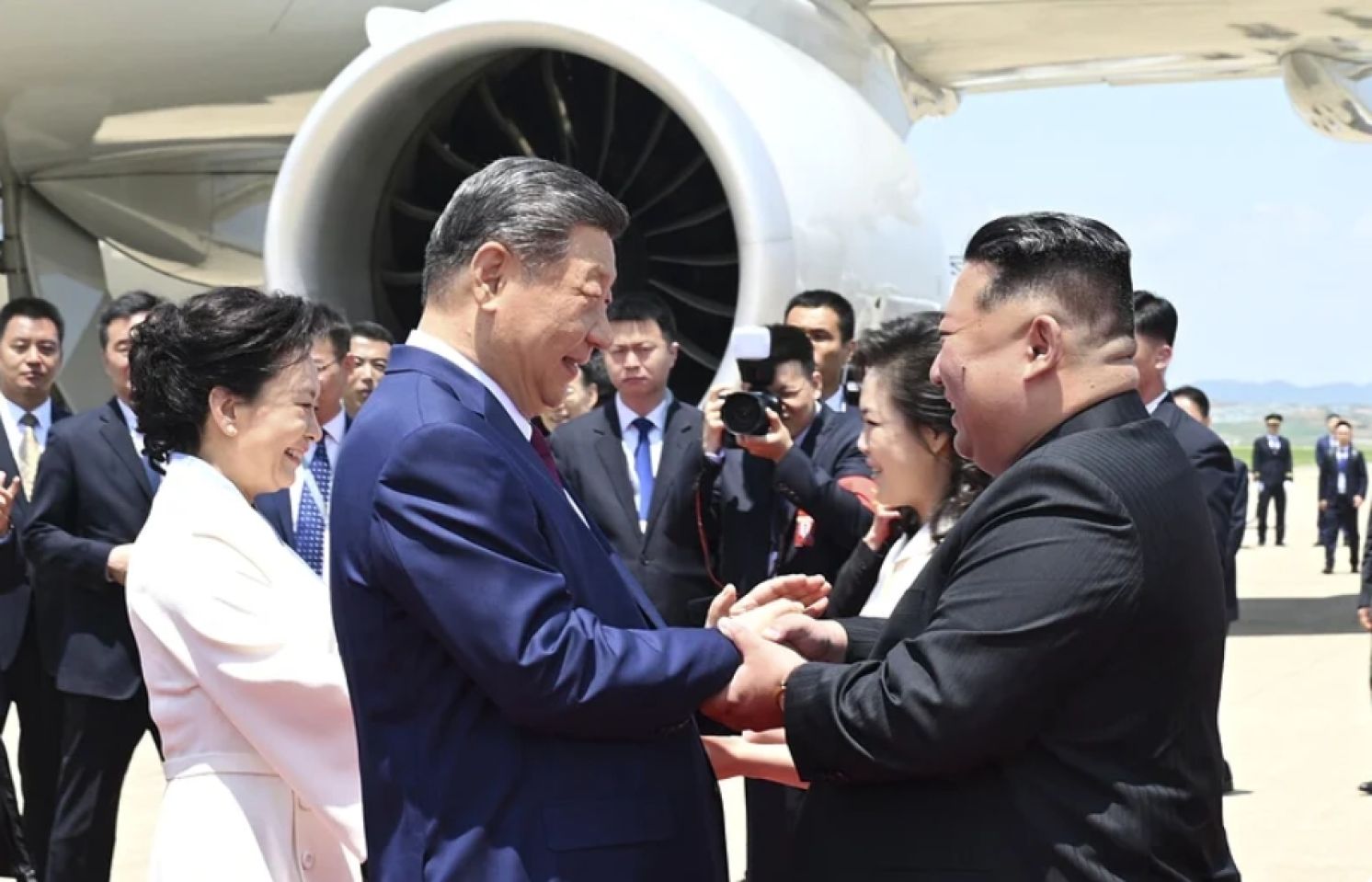
In June this year, Chinese President Xi Jinping visited Pyongyang for the first time in seven years. In August, mainland China’s Minister of Foreign Affairs Wang Yi visited South Korea and held talks with South Korean Foreign Minister Cho Hyun. According to a press release from China's Ministry of Foreign Affairs, Wang stated that China was willing to continue playing a constructive role in maintaining peace and stability on the Korean Peninsula, adding that "the United States also needs to change its long-standing hostile policy toward North Korea." He further stated that China welcomed the prospect of "the two countries, South Korea and North Korea," gradually moving toward peaceful coexistence and ultimately achieving lasting peace and stability on the peninsula.
The remarks immediately sparked a backlash in South Korea. An editorial in the Chosun Ilbo noted that China's top diplomatic leadership had never previously characterized North and South Korea so explicitly as two independent countries. Citing the 1992 communiqué establishing diplomatic relations between China and South Korea, the editorial pointed out that Beijing had then expressed respect and support for the Korean people's pursuit of peaceful reunification. It also raised a pointed question: If China can refer to the two Koreas as two separate countries, then could South Korea likewise refer to China and Taiwan as two countries?
In early September, South Korean National Security Adviser Wi Sung-lac publicly stated that this characterization differed from Seoul's position and expressed serious concern. He emphasized that describing the two Koreas as "two countries" would only push them further away from reunification. However, he also revealed that Mr. Wang had not mentioned "two countries" during their meeting, and that South Korea's concern centered on the wording used in China's publicly released documents.
Mr. Kim declared in 2023 that relations between the two Koreas had become those of "two hostile states." In May this year, South Korea released the full text of North Korea's revised constitution, which had removed all references to reunification. The new constitution also introduced a territorial provision stipulating that North Korea's territory borders the Republic of Korea to the south. Through its revised constitution, North Korea has explicitly defined inter-Korean relations as relations between two separate states. Against this backdrop, the wording in the aforementioned Chinese document effectively signaled Beijing's endorsement of this position.
Beijing has also stopped referring to the "denuclearization" of the Korean Peninsula, fueling speculation that China has tacitly accepted North Korea's possession of nuclear weapons. On denuclearization, the status of inter-Korean relations, and the Taiwan issue, an emerging pattern of mutual support and exchanges of strategic interests between China and North Korea has become increasingly apparent.
The practical impact of North Korea's latest criticism of U.S. arms sales to Taiwan remains to be seen. What cannot be overlooked, however, is that Mr. Trump has repeatedly made friendly overtures toward Mr. Kim in recent months. Mr. Trump has said that he expects to meet Mr. Kim later this year and has described their relationship as very good. Earlier, he also ordered a reduction in joint U.S.-South Korean military exercises. Beyond putting pressure on South Korea, the move may also have been intended as a gesture of goodwill towards Mr. Kim, aimed at encouraging North Korea to return to the negotiating table.
North Korea's diplomatic options are not limited to China and the United States. Since Russia and North Korea signed a mutual defense treaty in June 2024, relations between Pyongyang and Moscow have warmed considerably. North Korea is estimated to have deployed approximately 15,000 troops to support Russia in the war against Ukraine. Beijing's current efforts to draw Pyongyang closer can, to some extent, be seen as competition with Moscow for influence over North Korea.
What is particularly intriguing is that Beijing insists on the "One China” principle when it comes to Taiwan, while simultaneously using the term "two countries" to describe North and South Korea. South Korean media have also highlighted this inconsistency. This demonstrates how statements by major powers often serve their immediate strategic interests, while the Taiwan Strait is increasingly being incorporated into the calculations of various external powers.