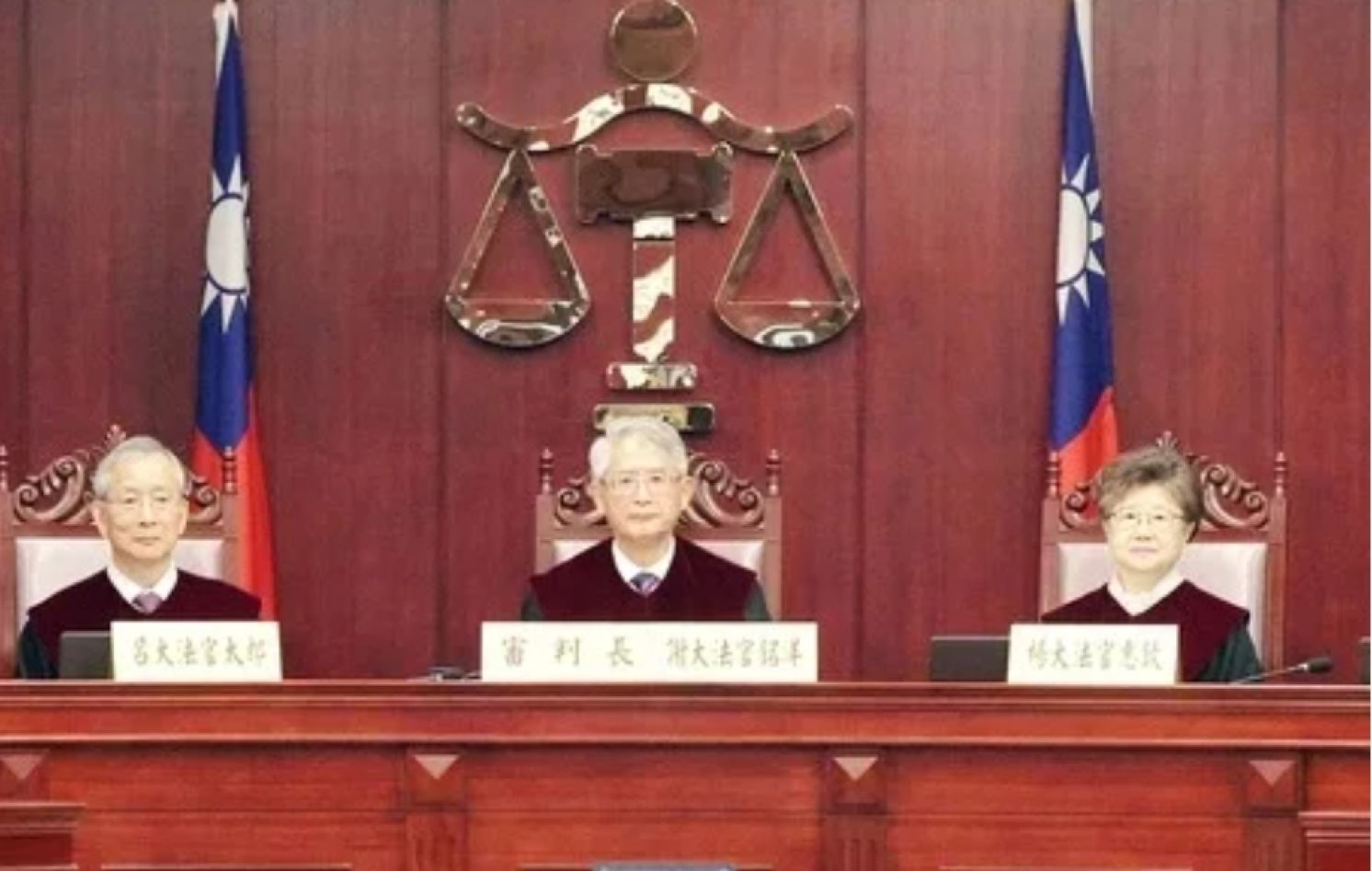
Disregarding Statutory Thresholds, Five Grand Justices Issue Rule on Their Own
China Times Opinion, December 20, 2025
Just as Premier Cho Jung-tai’s refusal to counter-sign the Fiscal Allocation Act ignited a constitutional storm, the Constitutional Court—paralyzed for more than a year due to an insufficient number of grand justices—suddenly “came back to life” and issued a ruling declaring the Constitutional Court Procedure Act unconstitutional. The intent is obvious: to bail out President Lai Ching-te and Cho. Going forward, Premier Cho will no longer need to resort to the tactic of “non-counter-signature.” Any bill he finds objectionable can simply be handed to these grand justices friendly to the ruling Democratic Progressive Party (DPP) to be struck down as unconstitutional, once again casting a political shadow over the judiciary.
To prevent a small number of DPP-friendly grand justices from dominating constitutional interpretation, opposition parties jointly passed amendments to the Constitutional Court Procedure Act at the end of last year, stipulating that no fewer than 10 grand justices may hear a case, and that at least nine must concur to declare a law unconstitutional. The bill was promulgated by President Lai in January this year, after which the DPP caucus immediately petitioned the Constitutional Court for provisional measures and constitutional interpretation.
The Lai administration had originally hoped—just as in the constitutional interpretations of the Act Governing the Legislative Yuan’s Exercise of Power and amendments to the Criminal Code—to immediately block the implementation of the Constitutional Court Procedure Act. However, due to internal divisions among the grand justices, coupled with repeated rejections of Lai’s nominees amid accusations of patronage and bias, the Constitutional Court remained stalled for over a year without convening.
Unexpectedly, Premier Cho Jung-tai’s refusal to counter-sign the Fiscal Allocation Act recently triggered widespread public backlash. Even legal scholars with pro-green leanings deemed the move unconstitutional. To defuse the constitutional crisis sparked by President Lai and Premier Cho, the DPP had long been laying the groundwork to “revive” the Constitutional Court.
On the 15th of this month, President Lai hosted an inter-branch policy meeting at the Presidential Office Building with the heads of the Executive Yuan and Examination Yuan. Green heavyweights, including Kaohsiung Mayor Chen Chi-mai, openly called on the Constitutional Court to resume operations as soon as possible to resolve partisan disputes.
Soon after, DPP-leaning media ran “exclusive reports,” citing informed sources to predict that the “Constitutional Court was about to make a grand comeback.” These reports explicitly claimed that the grand justices were targeting the shackles placed on the Court, seeking to break free from the Legislative Yuan’s constraints and rule on the constitutionality of the Constitutional Court Procedure Act. The Judicial Yuan’s calendar was also found to include scheduled deliberations by the grand justices, with internal sources already indicating that the aim was to restart the Constitutional Court.
This round of constitutional interpretation, in which the grand justices excluded dissenting views and issued a ruling in violation of the law, precisely demonstrates that the political black hand of the Office of the President and Executive Yuan has reached into the judiciary.
Going forward, these grand justices will not only be able to issue interpretations declaring “non-countersignature and non-implementation” constitutional for Lai and Cho, but may even render the premier’s use of “non-countersignature” unnecessary. Any law that fails to align with their preferences can simply be sent to these grand justices to be ruled unconstitutional. The Lai-Cho system, working hand in hand with the grand justices, has written the darkest and dirtiest page in Taiwan’s judicial and constitutional history.
From: https://www.chinatimes.com/newspapers/20251220000406-260121?chdtv