China Will Seize Opportunity to Consolidate Dominance in East Asia
United Daily News Commentary, January 21, 2026
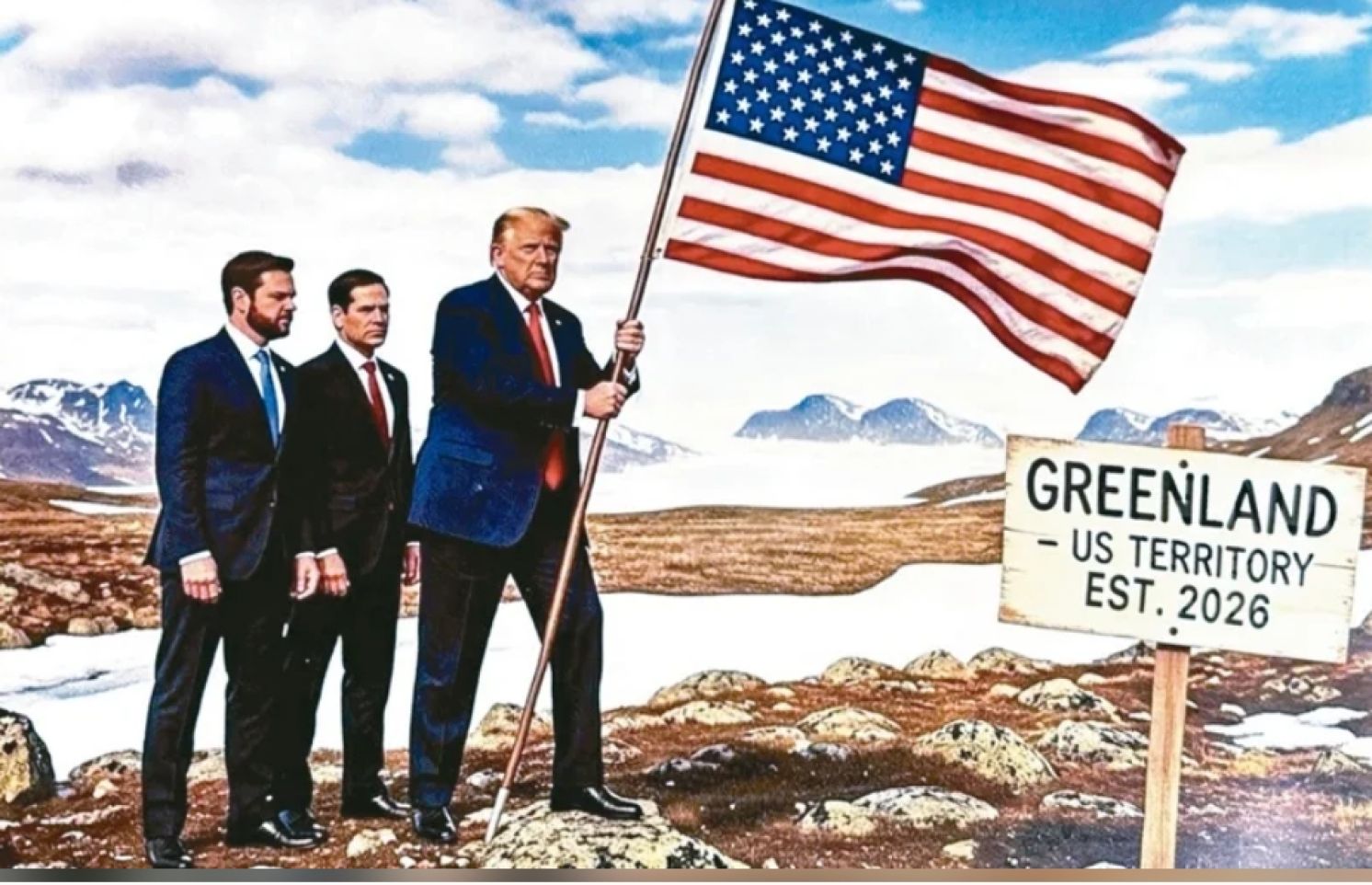
President Donald Trump of the United States has declared that the incorporation of Greenland into the country is “irreversible.” Therefore, this issue is no longer a low-probability, idle topic, but will be a “black swan” event forcing a dramatic historical turn.
Even Russia is egging Mr. Trump on. A week ago, Dmitry Medvedev, Vice Chairman of the Russian Security Council, said, “If Trump does not act quickly to secure the Arctic island of Greenland, the Greenlanders may vote to join Russia.” This remark may seem ironic but is more of a deception, reinforcing the logic that both China and Russia are coveting Greenland, pushing Mr. Trump to decide impulsively, out of fear, to swallow this northern barren island.
Thus, the discussion is no longer about whether Trump will actually do it, but about what the world would look like if the United States annexes Greenland.
First, by taking Greenland, the United States would gain full control of the entire western Arctic coastline from Alaska to Greenland, and form a pincer with NATO forces at the European end of the eastern coastline, effectively placing the Arctic under its control.
In this way, Russia’s strategic space would be compressed. Its Northern Fleet’s access to the Atlantic would be subject to tighter U.S. surveillance and constraints. Russia would likely have to commit massive resources to safeguard its Arctic interests, which would reduce the pressure Japan feels from Russia in Northeast Asia.
This would also severely damage China’s interests. In 2018, Beijing published its first White Paper on China’s Arctic Policy, declaring China a “near-Arctic state” and asserting its participation in Arctic route development, resource utilization, and governance. American control of Greenland could dominate the Arctic Council, excluding China from Arctic affairs and frustrating its hopes to participate in governance and develop Arctic shipping lanes. In other words, China’s efforts to open alternative trade routes beyond its established South China Sea–Malacca–Indian Ocean corridor would suffer a heavy blow.
Second, from a military-strategic perspective, Greenland’s existing Thule (Pituffik) Air Base could be expanded, allowing denser deployment of U.S. ballistic missile warning and space surveillance assets. It could even serve as a forward base for offensive weapons such as medium-range missiles, stealth aircraft, and strategic bombers, directly deterring Russia and the entire Eurasian landmass.
However, the cost of these strategic benefits would be very high. First, Europe’s trust in Article 5 of the North Atlantic Treaty—the “collective defense clause”—would be directly undermined. This would constitute a territorial dispute among NATO members and the first instance of a pillar NATO state aggressing against other members, completely different from the Cod Wars between the United Kingdom and Iceland years ago, or Turkey’s invasion of Cyprus.
This does not necessarily lead to NATO’s collapse, but it would render the alliance largely symbolic, deepen mutual suspicion among member states, and could result in hierarchical vassalage and partial regional bloc formation.
Second, this is not entirely bad for China. The United States would likely have to commit enormous resources and financial expenditure to achieve effective control over this newly acquired vast territory, which could crowd out its strategic engagement and presence in the Indo-Pacific region, particularly the Western Pacific. In other words, China’s dominant position in the Western Pacific would be further deepened and consolidated.
More seriously, annexing Greenland would inevitably trigger European doubts about American hegemony, causing severe cracks in the previously conceptual Western alliance. The foundation for coordinated Western resistance to China based on shared values would be hollowed out, leaving a fragmented West less capable of containing China. For Taiwan, this may not be a favorable development.
Greenland, snow-covered and seemingly harmless, could nonetheless trigger geopolitical fissures that might undo the long-term stability achieved since World War II, pushing humanity back toward turbulence. The global great-power competition landscape could shift from the traditional contest over Eurasia’s peripheral fortresses or hubs to a three-dimensional confrontation centered on the Arctic, radiating across Eurasia and North America.
The geopolitical shockwaves triggered by that distant island in the North Atlantic will ultimately reach the Taiwan Strait. Taiwan must recognize that American power may gradually but steadily wane in this region over the long term.