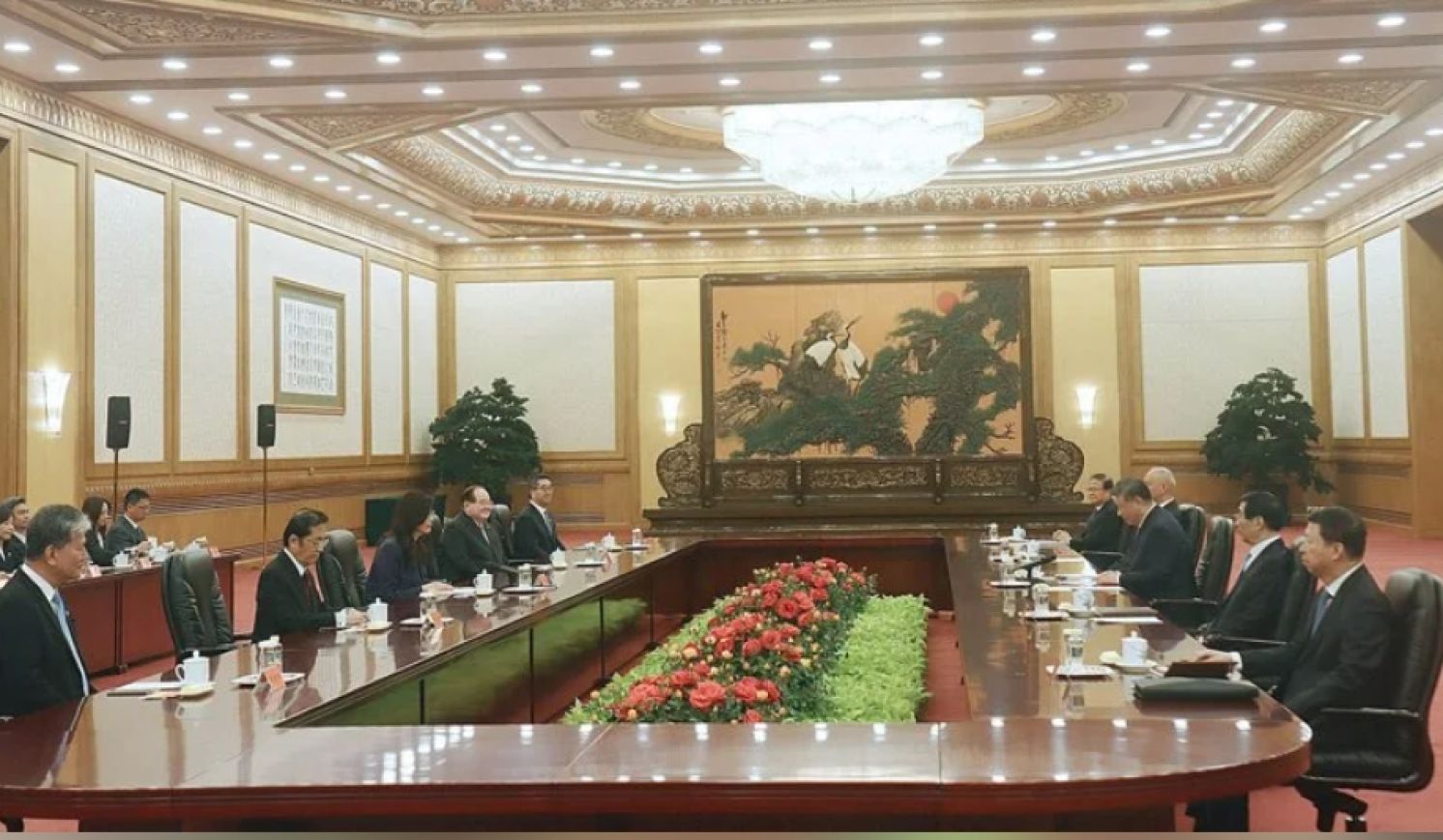
Cheng Promotes “Make Taiwan Prosper through Peace" Narrative, Challenging DPP Stance
United Daily News Editorial, April 12, 2026
As Chairwoman Cheng Li-wun of the Kuomintang (KMT) sat down with Chinese President Xi Jinping for talks in Beijing, the “Cheng–Xi meeting” not only marked the resumption of inter-party dialogue but also resembled a direct fastball thrown into the heart of the year-end local elections, reshaping the narrative structure. The key lies not in what Mr. Xi said, but in the “making Taiwan prosper through peace” framework that Ms. Cheng introduced in Beijing—an attempt to replace the long-entrenched independence–unification debate with a more operational paradigm, challenging the ruling Democratic Progressive Party’s (DPP) “resist China to protect Taiwan” narrative and shifting the campaign focus from identity confrontation to risk governance and development choices.
At its core, this contest is about the rise and fall of two political languages. Over the past decade, the DPP has built a solid mobilization structure around “resist China to protect Taiwan,” amplifying threats and consolidating identity into a binary value framework: to ensure security, one must resist; to safeguard sovereignty, ambiguity is not an option. However, as this narrative has long relied on external pressure to sustain its tension, its marginal returns inevitably diminish. As public sentiment shifts from anger to fatigue, an unavoidable crack has emerged—it can amplify crises, but it cannot reduce risks.
It is precisely within this gap that “making Taiwan prosper through peace” finds its entry point. Rather than denying security concerns, Ms. Cheng reframes the question itself: instead of asking whether to resist, ask how to avoid war; instead of being trapped in the independence–unification dialectic, calculate the dividends of peace. The sophistication of this strategy lies in not directly challenging sovereignty discourse, but subtly shifting the evaluative criteria—from ideological correctness to governance effectiveness. As voters begin to consider scenarios of military tension in the Taiwan Strait, investment risks, and industrial relocation, “making Taiwan prosper through peace” evolves from a slogan into a choice grounded in real-world consequences. The devastation of global conflicts further reinforces this sense of imminent crisis among Taiwan’s public.
For the KMT, this also represents a strategic recalibration both internally and externally. Traditionally, KMT local candidates have been most vulnerable in the final stages of elections, when identity labels overshadow governance performance. Through the high-level interaction of the Cheng–Xi meeting, Ms. Cheng is effectively reclaiming narrative authority for the party—reframing cross-strait issues from a liability into an opportunity. When agricultural exports, tourism recovery, and regional economic integration are all recast as components of peace dividends, local politics gains a more expansive narrative space.
By contrast, the standard response by the administration of President Lai Ching-te reveals a strategic dilemma. Continuing to emphasize threats from mainland China may heighten voters’ demand for risk-reduction solutions; attempting to de-escalate, however, risks weakening its long-standing mobilization base. As a result, the DPP’s response often remains confined to questioning the opposition’s legitimacy and raising concerns over united front tactics, without addressing a more straightforward question: If dialogue is not viable, then how will risks be reduced? If conflict is unavoidable, then who will bear the costs? What concrete solutions can the government offer? For voters, the political party which can lower the probability of war and stabilize the economy will ultimately be more compelling.
Indeed, skepticism towards “making Taiwan prosper through peace” persists: What is the price of peace? If its endpoint entails erosion of sovereignty or a drift toward a variant of “One Country, Two Systems,” then even the most refined narrative may struggle against public backlash. Ms. Cheng has deliberately maintained ambiguity, underscoring functional cooperation while downplaying political endgames, using “de-escalation first, competition later” as a transitional narrative. While the structural question of “One China” cannot be avoided in the long run, suspending ultimate debates and focusing on the process of peaceful development clearly carries more immediate practical significance.
Ultimately, the true significance of this debate lies in who can redefine the problem. As the independence–unification divide gradually loses its mobilizing power and “risk management” and “development pathways” become new reference points, Taiwan’s politics is undergoing a quiet yet profound shift. The “making Taiwan prosper through peace” discourse seeks to replace ideology with realism, while “resist China to protect Taiwan” risks becoming an increasingly ineffective and dated narrative. The tension between the two narratives is reshaping how voters make their judgments.
Chairwoman Cheng’s “making Taiwan prosper through peace” narrative has already begun to subtly alter the trajectory of the election. The question now is whether the KMT can seize this opportunity—and whether voters’ choices will ultimately validate the Cheng–Xi meeting as the “major electoral advantage” that she claims it to be.