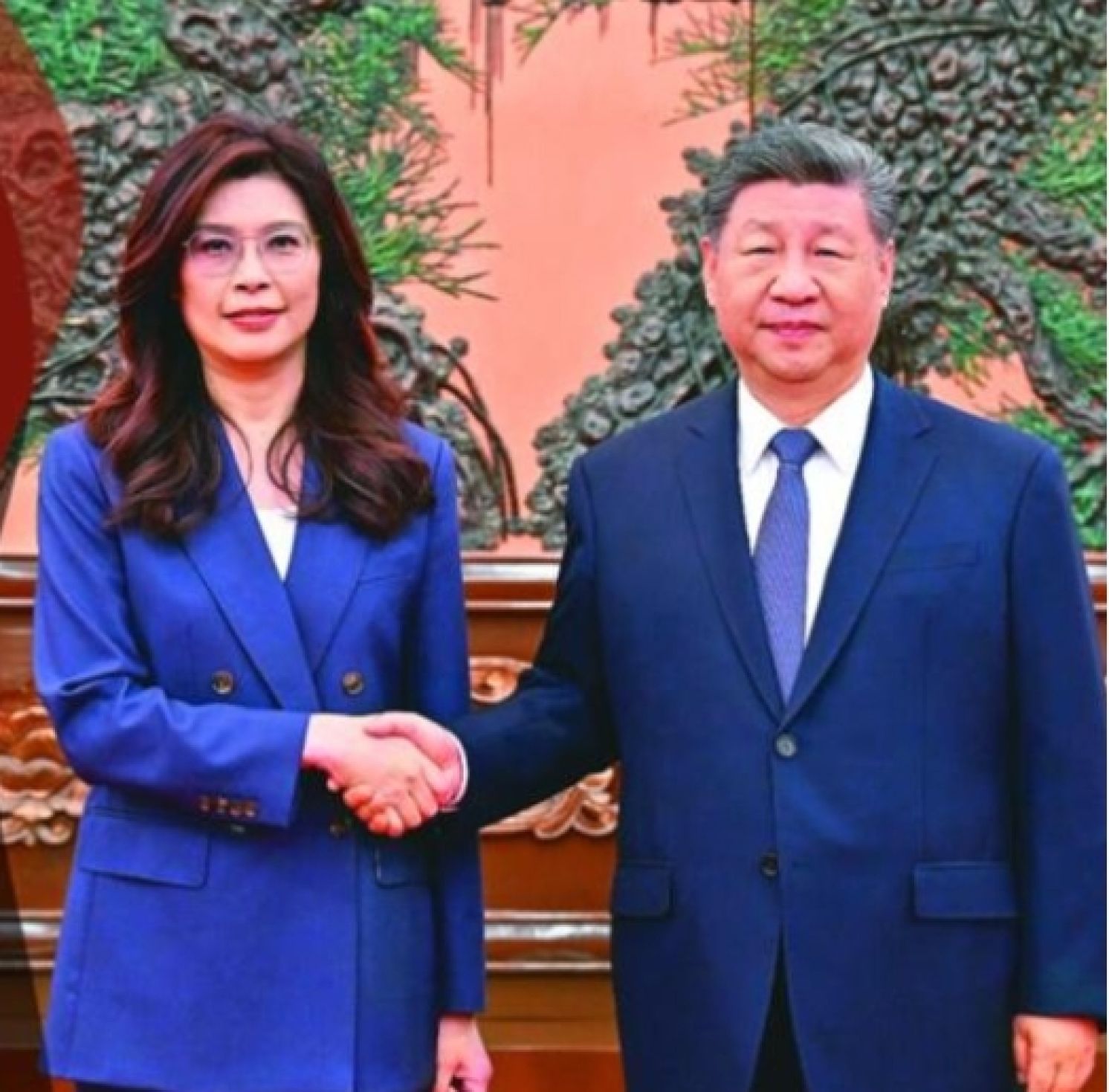
Can Dividends of KMT-CCP Reconciliation Extend to Cross-Strait Peace?
By Chao Chun-shan, United Daily News Opinion, April 11, 2026
The meeting on April 10 between Chairwoman Cheng Li-wun of the Kuomintang (KMT) and General Secretary Xi Jinping of the Chinese Communist Party (CCP) in Beijing brought her “peace trip” to a smooth close. Yet, as the saying goes, “the people may part, but the melody lingers”—there remains a long and difficult road ahead before lasting cross-strait peace can be achieved.
The agenda and format of this Cheng–Xi meeting appeared to mirror the meeting between then-President Ma Ying-jeou and Mr. Xi held in Singapore in November 2015. It followed the principle of “seeking common ground while reserving differences,” allowing each side to restate its established positions while leaving room for tacit mutual understanding.
Judging from the public remarks made by both Ms. Cheng and Mr. Xi, the most significant outcome of this meeting was the shared aspiration to foster a “cross-strait community of shared destiny” through ethnic and cultural ties. This would be built upon adherence to the “1992 Consensus” and opposition to “Taiwan independence,” with the aim of establishing an institutionalized framework for cross-strait peace.
Whether this meeting can generate a spillover effect—transforming the “reconciliation dividend” between the KMT and the CCP into a broader “peace dividend” across the Taiwan Strait—depends largely on whether the KMT can return to power. Having accompanied then-KMT Chairman Lien Chan on his 2005 visit to mainland China, Ms. Cheng likely understands this dynamic well.
Looking back, after Ma Ying-jeou was elected KMT chairman in July of that same year, he incorporated the five visions from Chairman’s meeting with then CCP General Secretary Hu Jintao into the party platform, which later became key elements of his 2008 presidential campaign. Mr. Ma once remarked that by embracing the “1992 Consensus,” he had “built a bridge of peace” across the Taiwan Strait.
Under President Ma, cross-strait dialogue steadily intensified. The Taiwan Strait remained peaceful, a “diplomatic truce” was maintained, and the two sides signed 23 agreements, including the Economic Cooperation Framework Agreement (ECFA). Beijing highly praised this period as eight years of “great exchange, great cooperation, and great development,” with Mr. Xi viewing it as a major achievement early in his tenure.
In contrast to Mr. Ma’s situation after the Lien–Hu meeting, Chairwoman Cheng now faces a very different landscape. While the Cheng–Xi meeting offers her an opportunity to define her place in history, it also presents numerous challenges both within and outside her party.
First, Ms. Cheng must establish central leadership authority and effectively consolidate internal consensus on cross-strait policy. Her rise to the KMT chairmanship reflects the party’s desire for renewal and change; however, to more traditional party members, her political background and style remain somewhat unconventional.
Second, she must determine how cross-strait policy can serve as a unifying force for the opposition. Any cooperation between the KMT and other opposition parties cannot rely solely on pragmatic interests—alliances formed by shared interests may just as easily dissolve because of them.
Third, Ms. Cheng must respond to tactical adjustments in Beijing’s Taiwan policy. Since Mr. Xi proposed exploring a “one country, two systems Taiwan model,” the push for unification has become more prominent. Beijing is now advancing both “anti-independence” and “pro-unification” agendas simultaneously, employing both soft and hard approaches. While Cheng opposes Taiwan independence, she may not be able to avoid confronting the issue of unification.
Finally, Ms. Cheng must address American concerns regarding the KMT’s cross-strait policy. U.S. officials have publicly encouraged constructive dialogue between the two sides to resolve issues peacefully. However, given the absence of the Democratic Progressive Party (DPP) from this process, Washington is likely to scrutinize Cheng’s actions closely and with skepticism.
Ms. Cheng has emphasized a strategy of “balancing both the United States and China,” seeking equilibrium between engagement with Beijing and ties with Washington. Yet, amid mutual distrust among Taiwan, the United States, and mainland China, this approach resembles walking a tightrope—especially in the context of a U.S.-China relationship characterized by competition without outright rupture. She must be careful not to sacrifice one side while tending to the other.
In conclusion, as tensions between the DPP and China have escalated into a near adversarial relationship, the Cheng–Xi meeting is unlikely to alter the current cross-strait standoff under DPP governance. Unless Ms. Cheng’s peace initiative can translate into electoral gains for the KMT in upcoming local and presidential elections, any “peace dialogue” between the KMT and CCP risks remaining little more than empty rhetoric.
The author is professor emeritus at the Institute of China Studies, Tamkang University.