Beijing Seizes Opportunity: First Island Chain Effectively Fractured
United Daily News Commentary, June 3, 2026
Japan and the Philippines have launched negotiations on delimiting their Exclusive Economic Zones (EEZs) and continental shelf maritime boundaries. The area under discussion lies in the waters off Taiwan’s eastern coast. The administration of President Lai Ching-te not only failed to protest but even echoed the move by stating that it was “consistent with our country's long-standing position” and expressing its “affirmation.” The government later revised its stance, saying that the Japan–Philippines negotiations “should not undermine Taiwan’s interests,” or that “consultation with Taiwan should occur if Taiwan’s interests are affected.”
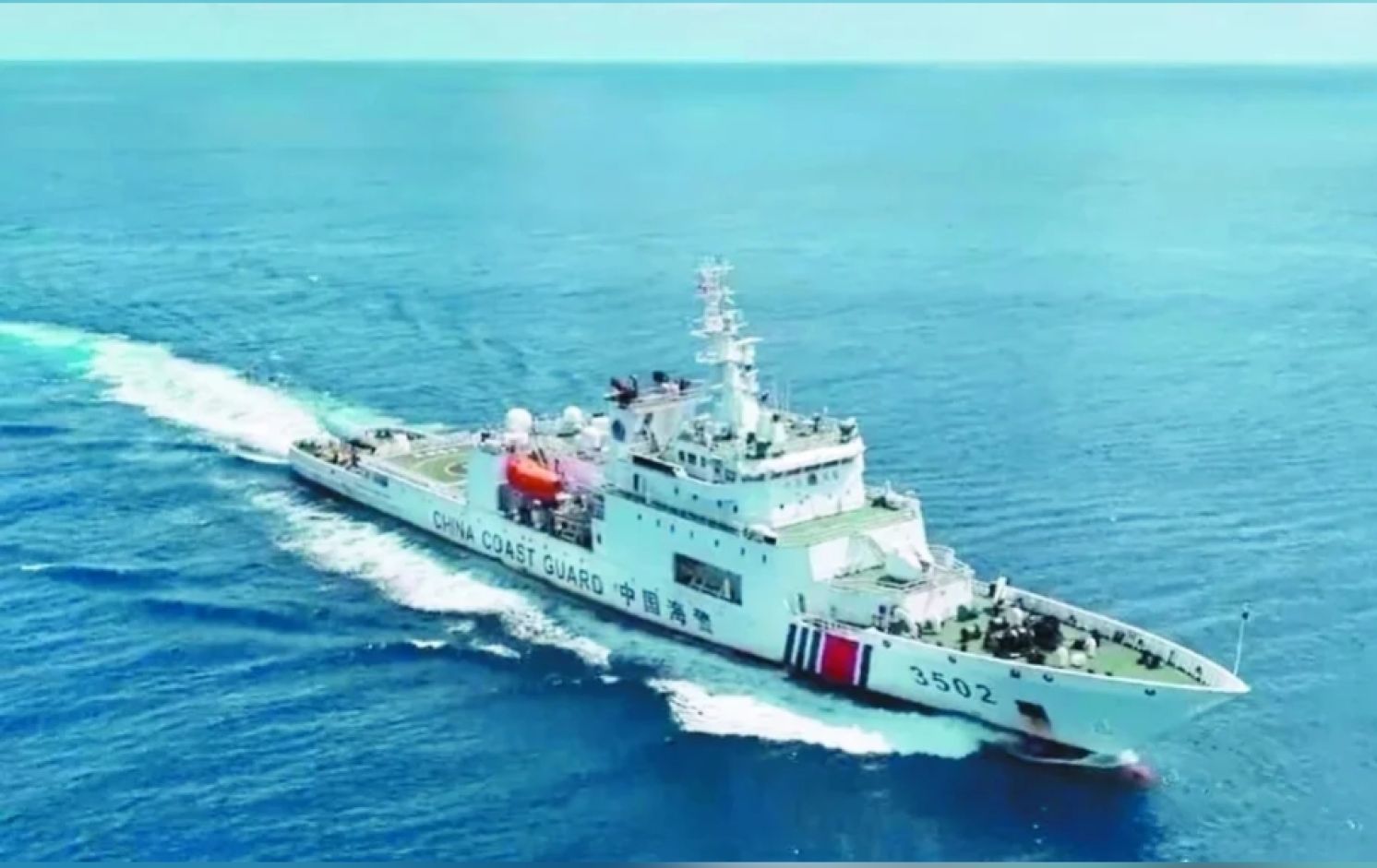
Meanwhile, the mainland Chinese Coast Guard has already taken action. On June 1, a formation led by mainland Coast Guard vessel Daishan appeared in waters east of Taiwan. This marked the first officially announced patrol by the mainland Coast Guard in waters east of Taiwan under the name of an independent law-enforcement operation.
In other words, Beijing has seized upon the Japan–Philippines delimitation negotiations as an opportunity to incorporate the waters east of Taiwan into its regular law-enforcement jurisdiction. Mainland China not only signals its rejection of the negotiations from the outset regardless of the final outcome but also extends its enforcement activities into waters east of Taiwan for the first time under the pretext of protecting maritime territory.
Yet this may also be a consequence of the Lai administration’s own making. The origin of the Japan–Philippines negotiations is that the Yaeyama Islands, the southernmost part of Japan’s Ryukyu Islands, and the Batan Islands north of Luzon in the Philippines are less than 400 nautical miles apart, making the claimed 200-nautical-mile EEZs of both sides overlap. However, this overlap also covers the EEZ claimed by Taiwan.
Yet in these waters claimed by all three parties, the Japan–Philippines negotiations have completely bypassed Taiwan. In effect, Taiwan has been treated as though it does not exist. For Beijing, Taiwan is part of China, and therefore these negotiations naturally disregard China’s maritime sovereignty claims as well.
Logically speaking, Taiwan should have demanded participation in the delimitation negotiations in the name of the Republic of China. If denied, it should, like Beijing in this instance, have solemnly declared that any such delimitation negotiations conducted without Taiwan’s participation are “entirely illegal and invalid” from the outset.
The increasingly frequent interactions between Japan and the Philippines in recent years are related to the decline of American power and Japan’s determination to seize the opportunity to break free from U.S. control and shed the shadow of its status as a defeated nation. Japan hopes to form a Japan–Philippines alliance that appears capable of tightening the First Island Chain. In confronting China, such an alliance provides reassurance for the desperate moment when the United States might truly withdraw from the First Island Chain.
At this moment, the Lai administration’s predicament may be even more conflicted than Japan’s. U.S. Secretary of Defense Pete Hegseth made no mention of Taiwan whatsoever at the Shangri-La Dialogue in Singapore. Taiwan has thus lost even U.S. verbal security assurances and increasingly appears to be a prohibited zone for American power projection. The deliberate exclusion of Taiwan from the Japan–Philippines negotiations also seems to tacitly acknowledge Beijing’s sovereignty claims over it.
No matter how much effort Japan and the Philippines invest, the final outcome will still be determined by power. Japan is seeking to deploy air-surveillance radar systems in northern Luzon through its Official Security Assistance (OSA) framework and plans to sell the Philippines decommissioned Abukuma-class anti-submarine destroyer escorts over time. In addition, the Japan–Philippines General Security of Military Information Agreement (GSOMIA), for which negotiations have already begun, will allow real-time intelligence sharing between the two countries. Yet none of these measures can alter the dominant position of the People’s Liberation Army (PLA) Navy and Air Force in this region.
For Taiwan, the current Japan–Philippines EEZ negotiations are clearly bad news. By providing a pretext that Japan is eyeing the waters east of Taiwan, they have conveniently enabled Beijing to send government law-enforcement vessels into the area openly and legitimately.
From now on, it may become routine for the mainland Chinese Coast Guard vessels to claim that they are protecting Taiwanese fishermen from interference by Japanese and Philippine enforcement vessels, and there may at any time be an aircraft carrier standing guard in the outer perimeter. The First Island Chain is truly breaking apart.