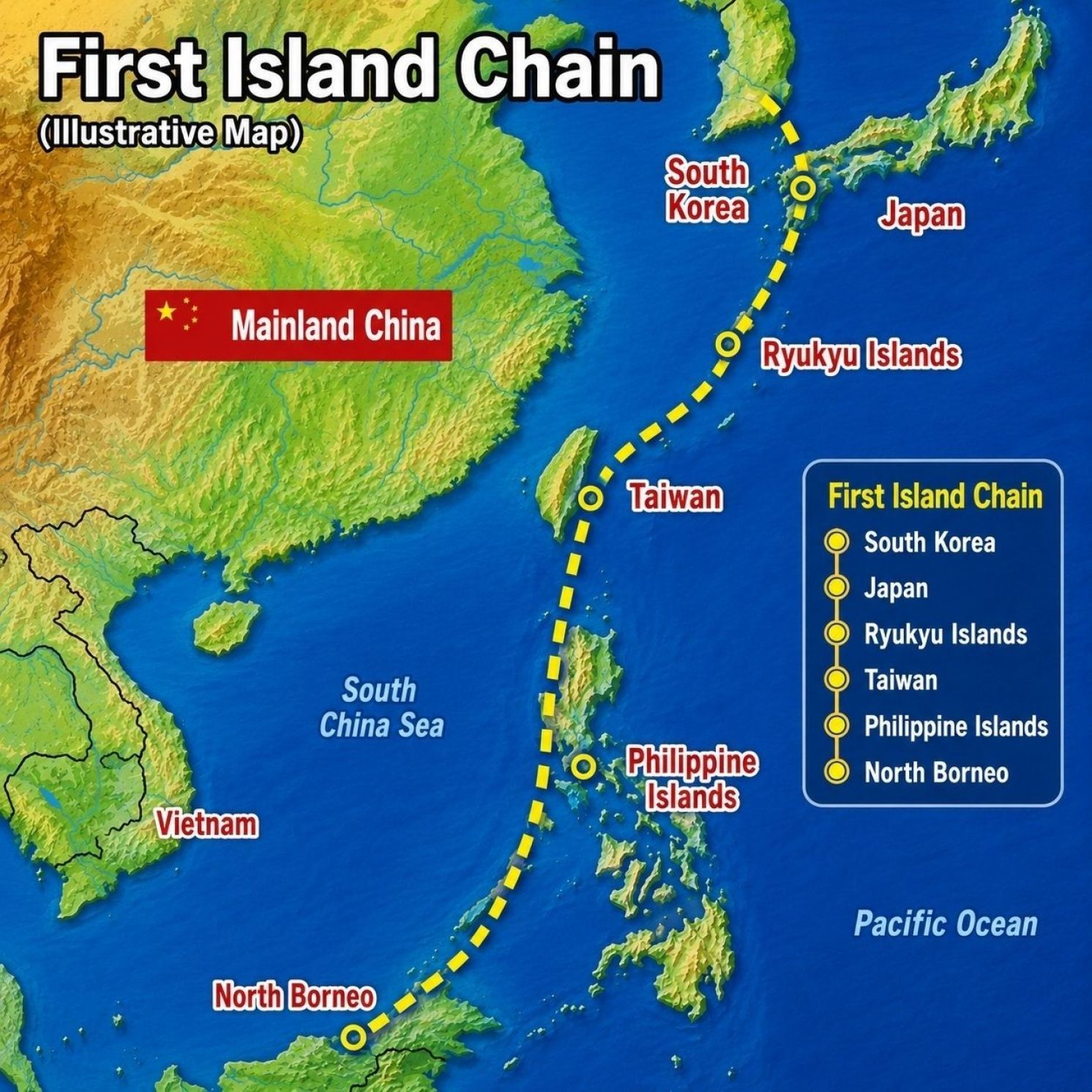
Beijing Constructing “Near-Shore Governance” to Counter First Island Chain
United Daily News Report, June 21, 2026
A core shift in the “U.S. National Security Strategy” released by the Trump administration at the end of 2025 is its explicit statement that the United States is no longer willing to bear the role of a one-sided protector. Instead, it openly demands that allies and partners along the first island chain significantly increase their own responsibilities. This has likely been interpreted by Beijing as an American acceptance of the loss of the strategic foundation necessary to comprehensively contain China through the first island chain as a geopolitical pivot. America’s voluntary display of weakness has evidently encouraged China’s growing desire to push forward and break through.
On May 28, following a summit between the leaders of Japan and the Philippines, the two countries issued a joint statement announcing their decision to begin negotiations on maritime boundaries concerning their Exclusive Economic Zones and continental shelves. In response, on June 1, the China Coast Guard declared that it would conduct “law enforcement patrols” in waters east of Taiwan, citing the unauthorized initiation by Japan and the Philippines of maritime boundary negotiations in waters east of Taiwan and claiming that such actions had seriously infringed upon China’s interests.
In fact, since President Lai Ching-te took office, the China Coast Guard has appeared in waters surrounding Taiwan during various People’s Liberation Army (PLA) military exercises over the past two years, including “Joint Sword–2024A.” However, those appearances were conducted in coordination with the PLA as part of joint exercises and were not focused on waters east of Taiwan. The June 1 operation, by contrast, marked the first time that the China Coast Guard independently entered waters east of Taiwan under the name of a “law enforcement patrol.”
Zhang Junshe, a mainland Chinese military expert who has long followed coast guard operations, stated that this action demonstrated that the mainland had fully mastered the local marine environment, hydrological and meteorological conditions, and navigation routes. He added that supporting systems are mature and comprehensive, giving China the capability to conduct long-term missions in these waters. Meanwhile, “Yuyuan Tantian,” a new media platform affiliated with China Central Television (CCTV), stated that through this operation, the China Coast Guard had told the world that “the relevant waters east of Taiwan Island are waters under China’s jurisdiction.”
Subsequently, from June 6 to June 10, mainland China’s Ministry of Transport announced the implementation of a special maritime traffic law enforcement and surveying operation in waters east of Taiwan. This marked the first time that the mainland had conducted surveying activities in waters east of Taiwan under the framework of maritime traffic law enforcement. Immediately afterward, the mainland’s Ministry of Natural Resources carried out a marine environmental survey in waters east of Taiwan from June 16 to June 18.
“Yuyuan Tantian” described this recent series of actions by multiple mainland Chinese government agencies as a “near-seas governance model.” In other words, Communist China has already incorporated waters east of Taiwan into its “near seas” through practical actions. Zhu Songling, a professor at the Taiwan Research Institute of Beijing Union University, told China Review News that this signifies the mainland’s management of waters surrounding Taiwan Island has expanded from the inner side of the Taiwan Strait to the eastern side of Taiwan, evolved from single coast guard patrols to comprehensive transportation law enforcement, and advanced from simple declarations of rights to a complete governance framework.
The intention extends beyond merely transforming waters east of Taiwan into “near seas.” Over the past two years, the China Coast Guard has essentially conducted “rights protection patrols” around the Diaoyutai Islands and their affiliated islets every month, while also carrying out “law enforcement patrols” around Scarborough Shoal and surrounding waters. From the Diaoyutai Islands to Taiwan and then to Huangyan Island in the South China Sea, mainland China has established a normalized coast guard presence.
Yet in the face of the Communist China’s steady advance along the first island chain, the United States has taken almost no proactive action and has even accepted Beijing’s proposal to build a “constructive strategic stability relationship” between China and the United States. If the waters to the north, south, and east of Taiwan Island truly become China’s “near seas,” then does the “first island chain” defense strategy proposed by the United States 75 years ago still exist? Has the United States truly accepted that the first island chain falls within China’s sphere of influence and prepared itself to retreat to the second island chain?