Xi's "Velvet Glove and Iron Fist" Approach to Advance Unification, Challenge Cross-Strait Status Quo
United Daily News Commentary, November 15, 2026
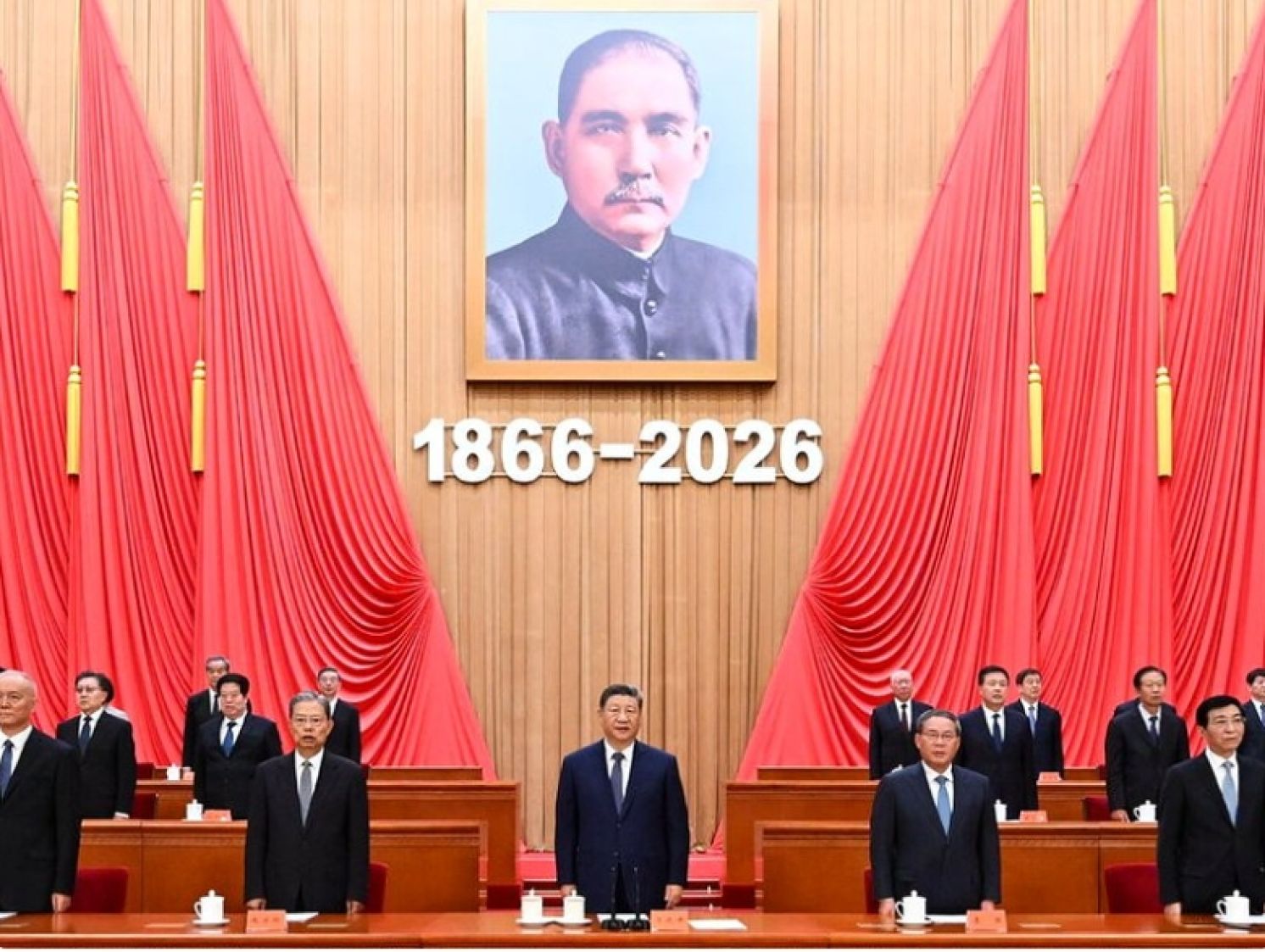
Former U.S. President Theodore Roosevelt's "Big Stick Diplomacy" is associated with the famous saying, "Speak softly and carry a big stick." The latest message on Taiwan policy conveyed by Chinese President Xi Jinping in his November 12 speech commemorating the 160th anniversary of Sun Yat-sen's birth carried a similar tone.
Compared with Mr. Xi's speech at the commemoration of the 150th anniversary of Sun Yat-sen's birth a decade ago, this year's address was a full one-third shorter. Its language concerning Taiwan was noticeably more moderate, yet it demonstrated an even firmer determination to advance the process of unification.
In 2016, Mr. Xi placed greater emphasis on "opposing Taiwan independence," declaring that "we will never allow any person, any organization, or any political party, at any time or in any form, to separate any part of Chinese territory from China."
This time, his remarks were considerably warmer. Mr. Xi said, "Compatriots on both sides of the Taiwan Strait are all Chinese. We are one family, bound by blood ties thicker than water. When family members interact, as long as they speak to one another respectfully and consult more frequently on matters of concern, there are no contradictions or differences that cannot be resolved."
Although this year's speech was more than 2,000 Chinese characters shorter, it devoted more attention to unification and Taiwan policy than the speech delivered a decade earlier. Xi made it clear that Taiwan has only one option for its future: unification.
As for how unification would be achieved, Mr. Xi reiterated his commitment to the policy of "peaceful reunification” and “One Country, Two Systems.” He stated that, on the basis of the “One China” principle and "1992 Consensus," the mainland is willing to engage in dialogue and consultations with people of insight from all sectors of Taiwan society on cross-strait relations and national unification. Mr. Xi also stated, "We will certainly give full consideration to Taiwan's actual circumstances and fully accommodate the interests and sentiments of our Taiwan compatriots, but we will never leave any room for separatist activities advocating 'Taiwan independence' in any form."
Mr. Xi's remarks conveyed several important messages. If unification is achieved peacefully, the mainland is willing to engage with people of insight from various sectors in Taiwan in dialogue and consultations on unification and the post-unification "One Country, Two Systems" plan for Taiwan. The bottom line, however, is that "patriots must govern Taiwan." In fact, an increasing number of people from different sectors in Taiwan have recently begun echoing Beijing's calls for political negotiations.
What if Taiwan refuses to accept the conciliatory approach, declines to come to the negotiating table, or even prohibits civil society groups, academics, and opposition parties from discussing unification with Beijing? In this regard, Communist China has never relaxed its preparations for the "hard approach."
Before Mr. Xi's November 12 speech, Secretary-General Joseph Wu of the National Security Council warned in a social media post on November 3 that the People's Liberation Army (PLA) had unusually assembled more than 100 naval vessels in the western Pacific. Subsequently, the U.S.-based Institute for the Study of War and the American Enterprise Institute jointly released a report suggesting that the PLA was likely conducting a large-scale "silent military exercise" simulating a blockade of Taiwan. The exercise was intended to prepare for an actual blockade in the future and undermine Taiwan's confidence in its own defensive capabilities.
If unification were achieved by force, or if Taiwan were compelled to enter negotiations under a PLA blockade, then the possible future “One Country, Two Systems” plan for Taiwan could be informed by the 12 recommendations formulated by more than 20 scholars convened in Beijing on September 12 by Hong Kong's Academy of One Country, Two Systems. Key proposals included stationing PLA troops in Taiwan, imposing three to five years of "quasi-military administration" and "patriotic education," and pursuing criminal accountability against leading radical Taiwan independence advocates. These 12 recommendations reportedly originated from the PLA.
Mr. Xi's November 12 speech conveyed, in moderate language, a firm determination to advance the process of unification. Meanwhile, the mainland's principal agencies responsible for Taiwan affairs are intensifying their deliberations on a "one country, two systems" plan for Taiwan. The political report to the Communist Party’s 21st National Congress next year is expected to elaborate further on this issue. Although the overwhelming majority of people in Taiwan hope that cross-strait relations can continue to maintain the status quo, whether that status quo can be preserved, and for how much longer, is increasingly beyond Taiwan's control.