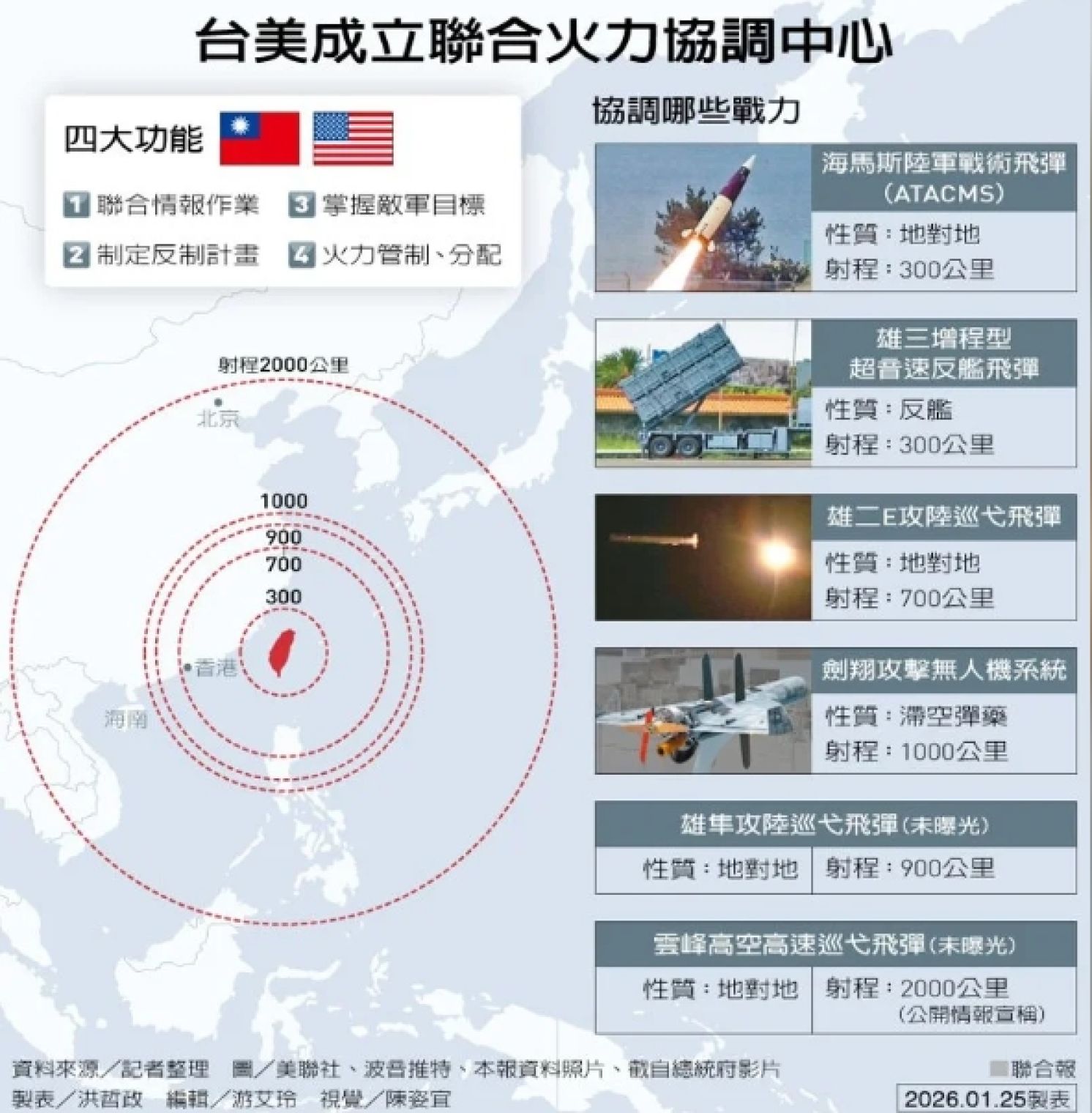
With Intelligence Coordination, U.S. Becomes Taiwan's "Supervisor"
United Daily News Report, January 26 2026
The Ministry of National Defense has newly established a high-level “Joint Firepower Coordination Center,” jointly operated by Taiwan and the United States to conduct intelligence coordination operations. This implies that, when necessary, the U.S. military will, through joint operations, provide Taiwan with targeting intelligence for various long-range missiles. Following years of actively promoting missile sales to Taiwan under the banner of “asymmetric warfare,” this is the sincerest step the United States has taken to operationalize deterrence preparedness.
This move by the United States may carry certain indicative significance, but the special defense procurement budget bill currently stalled in the Legislative Yuan is a domestic political issue. Its primary cause lies in the refusal by President Lai Ching-te’s administration in the central government’s general budget, to allocate funds for military pay raises that had already passed third reading amendments. The two issues should not be conflated and must be treated separately.
The United States has long demanded that Taiwan procure missiles, ranging from defensive air-defense missiles to, in recent years, land-attack missiles with greater deterrent effect against the People’s Liberation Army (PLA). Whether air-launched or ground-based, despite boasting long ranges, Taiwan lacks real-time military satellite reconnaissance capabilities. How to obtain intelligence on the PLA’s dynamic targets has always been a major problem.
Indigenously developed land-attack cruise missiles rely on preloaded mapping data to follow specific routes toward fixed enemy targets. Once targets become mobile, there is little that can be done. While the United States encourages Taiwan to adopt a “porcupine strategy” and purchase large numbers of missiles, this essentially means waiting to be struck first and then conducting passive defense as the enemy approaches. If “preemptive strikes” are desired, then Taiwan’s forces are effectively “severely nearsighted,” unable to see moving PLA forces at a distance across the strait.
The Joint Firepower Coordination Center, jointly staffed by personnel from Taiwan and the United States to conduct intelligence operations, means that if war breaks out in the Taiwan Strait—when U.S.-Taiwan interests intersect and consensus is reached—the Republic of China Armed Forces will have convenient channels to obtain real-time enemy movement intelligence collected by American assets, including long-range reconnaissance aircraft and military satellites. This would truly bring into play the asymmetric combat power of American-supplied weapons. For example, the Army’s actively deployed M142 HIMARS High Mobility Artillery Rocket System has no radar and relies solely on GPS coordinate receivers to guide precision rockets or tactical missiles. In wartime, dynamic coordinates of distant enemy forces across the strait would need to be provided by the U.S. military through the Joint Firepower Coordination Center, either to predefine attack plans or to enable rapid ad hoc transmission.
This mechanism serves as an intelligence-utilization platform attached to American equipment sales, and whether this platform will be linked with similar mechanisms under U.S. Indo-Pacific Command or U.S. Forces Japan leaves considerable room for speculation.
However, U.S.-Taiwan cooperation in constructing the Joint Firepower Coordination Center also means that, beyond the U.S. military’s “advisory authority” over whether American-made equipment may be employed, decisions over which targets across the strait can or cannot be struck, and whether to use indigenously produced or American-made missiles, will likely see strong American involvement. Whether in wartime or peacetime, this is, in essence, a form of “supervisory command.”