G2 Emerges: Who Will Determine Taiwan's Security?
By Chao Chien-min, United Daily News Opinion, November 21, 2026
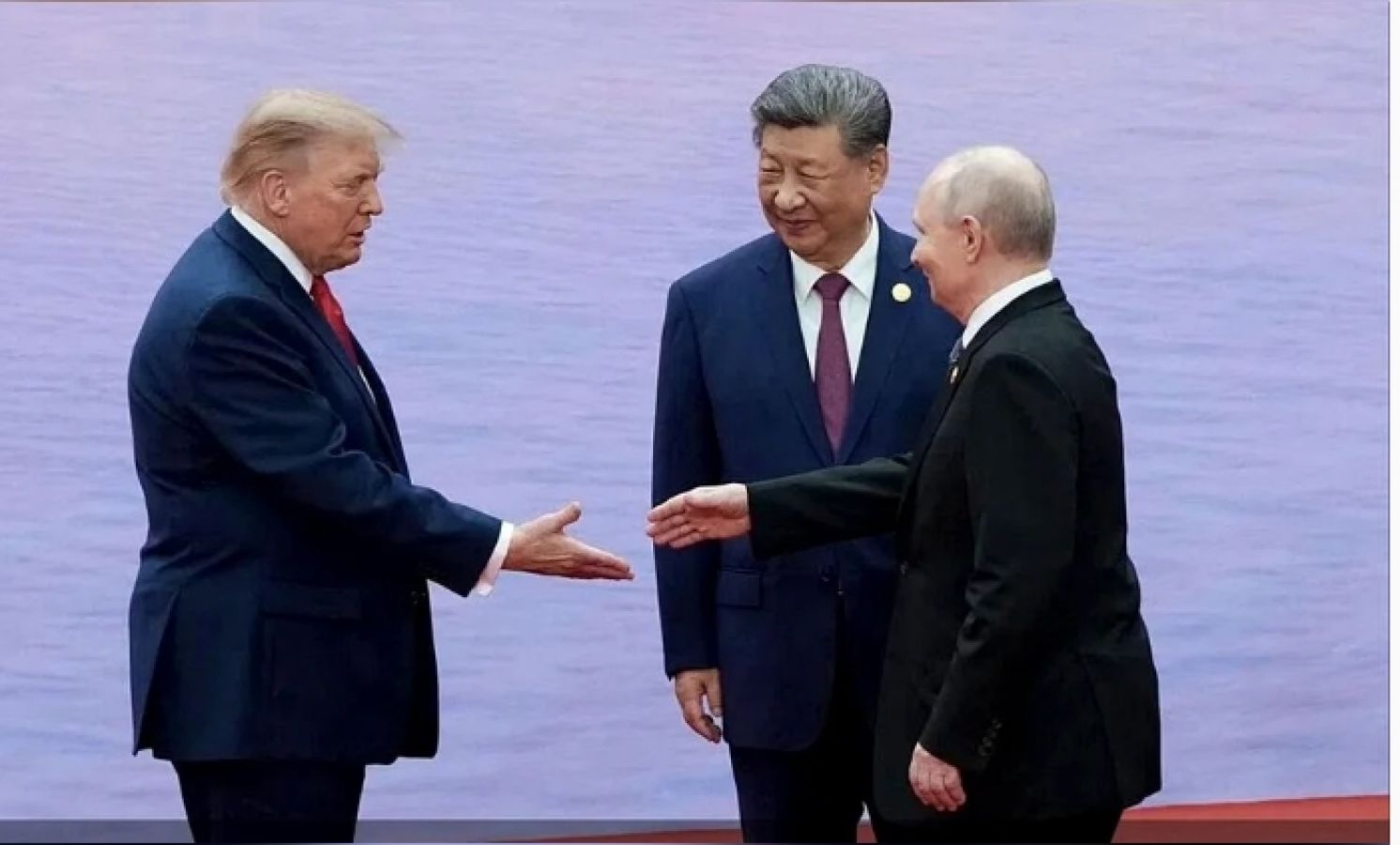
The leaders of the United States, China, and Russia held their first trilateral talks at the Asia-Pacific Economic Cooperation (APEC) summit in Shenzhen, discussing nuclear arms control, the war in Ukraine, and international security issues. Following the meeting, they issued a “peace declaration.” Many countries are concerned about the systemic implications of "joint governance by three powers" and the reemergence of a "secret Yalta agreement."
Judging from the four-point declaration, China was undoubtedly the biggest winner. It not only seized the opportunity to advance its long-standing vision of a new international order but also departed from its traditional refusal to negotiate over nuclear weapons, advocating their comprehensive prohibition and destruction. China also supported the proposal by Donald Trump of the United States to stabilize international energy markets, projecting the image of a responsible major power and counterbalancing Western concerns about the "rise of the East and decline of the West." More importantly, Beijing also secured endorsement of its core interests concerning territorial sovereignty and its path of development, effectively achieving three objectives at once.
Regarding Taiwan, Xinhua reported that Chinese President Xi Jinping stressed during the trilateral talks the importance of respecting territorial sovereignty and integrity, each country's system and development path, core interests and major concerns, noninterference in internal affairs, and the need to avoid crossing red lines. During the Trump-Xi meeting, Mr. Xi established a new definition of the bilateral relationship as one of constructive strategic stability, emphasizing constructive management of differences and the prevention of escalating tensions. He called on the United States to "persist in doing the right thing" on Taiwan. Mr. Trump, meanwhile, emphasized that the two countries were continuously strengthening cooperation in many areas, agreed to "address each other's concerns fairly," and expressed opposition to Taiwan independence.
The proceedings of this trilateral summit were not made public, and the declaration issued afterward was largely symbolic. The two preceding bilateral summits, between Mr. Trump and Mr. Putin and between Mr. Trump and Mr. Xi, appear to have produced more substantive outcomes. According to Moscow, Putin agreed to a U.S. compromise proposal for ending the war in Ukraine, although its actual contents remain unknown. Given that the United States and Russia had previously negotiated a ceasefire without the participation of the European Union or Ukraine, Ukrainian President Volodymyr Zelenskyy's concerns about a "second Yalta" were not unfounded. Meanwhile, Japanese Prime Minister Sanae Takaichi was cold-shouldered by both China and the United States during the APEC summit, leaving her isolated.
According to Mr. Trump, Taiwan had to be addressed at the U.S.-China summit. Combined with Mr. Trump's preference for conducting discussions behind closed doors, this has done nothing to alleviate Taiwan's concerns about its sovereignty. However, bargaining over sovereignty in international affairs requires the presence of an immediate and evident threat. Although the Taiwan Strait is a high-risk area, the conditions for a grand bargain are not yet present.
Mr. Trump's penchant for dealmaking is more likely to manifest itself in tactical exchanges of interests, such as adjustments to the wording of positions on opposition to Taiwan independence and unification, or a temporary suspension of arms sales.
Recently, at the commemoration of the 160th anniversary of Sun Yat-sen's birth, Mr. Xi declared that unification is an inevitable requirement for national rejuvenation and that no room would be left for separatist activities advocating Taiwan independence. This should be understood as Beijing's red line. In pursuit of the distinction of ending a war, Mr. Trump could sacrifice Ukraine's territorial sovereignty, a possibility that has shaken both Taiwan and Japan.
Russia lacks sufficient national strength and attended the summit merely to elevate its international standing. Following the Republican Party's crushing defeat in the U.S. midterm elections, Mr. Trump has become a lame-duck president ahead of schedule, and Congress is bound to constrain the White House on both domestic and foreign affairs.
Following the Nvidia incident, sentiment favoring stringent U.S. controls on China in the field of artificial intelligence (AI) has intensified. Mr. Trump's statement about "addressing each other's concerns fairly" echoes the mainland's red line. The deeper significance of the Shenzhen summit therefore appears to lie in the reaffirmation of a U.S.-China G2 framework. The real picture of power emerging from this summit is one of U.S. strategic retrenchment, Japan's marginalization, and an East Asian international order increasingly managed jointly by the United States and China.
(The author is former dean of the College of Social Sciences, Chinese Culture University, and former deputy minister of the Mainland Affairs Council.)