From War Preparedness to Confrontation: President Lai's Peace Trap
China Times Editorial, August 26, 2026
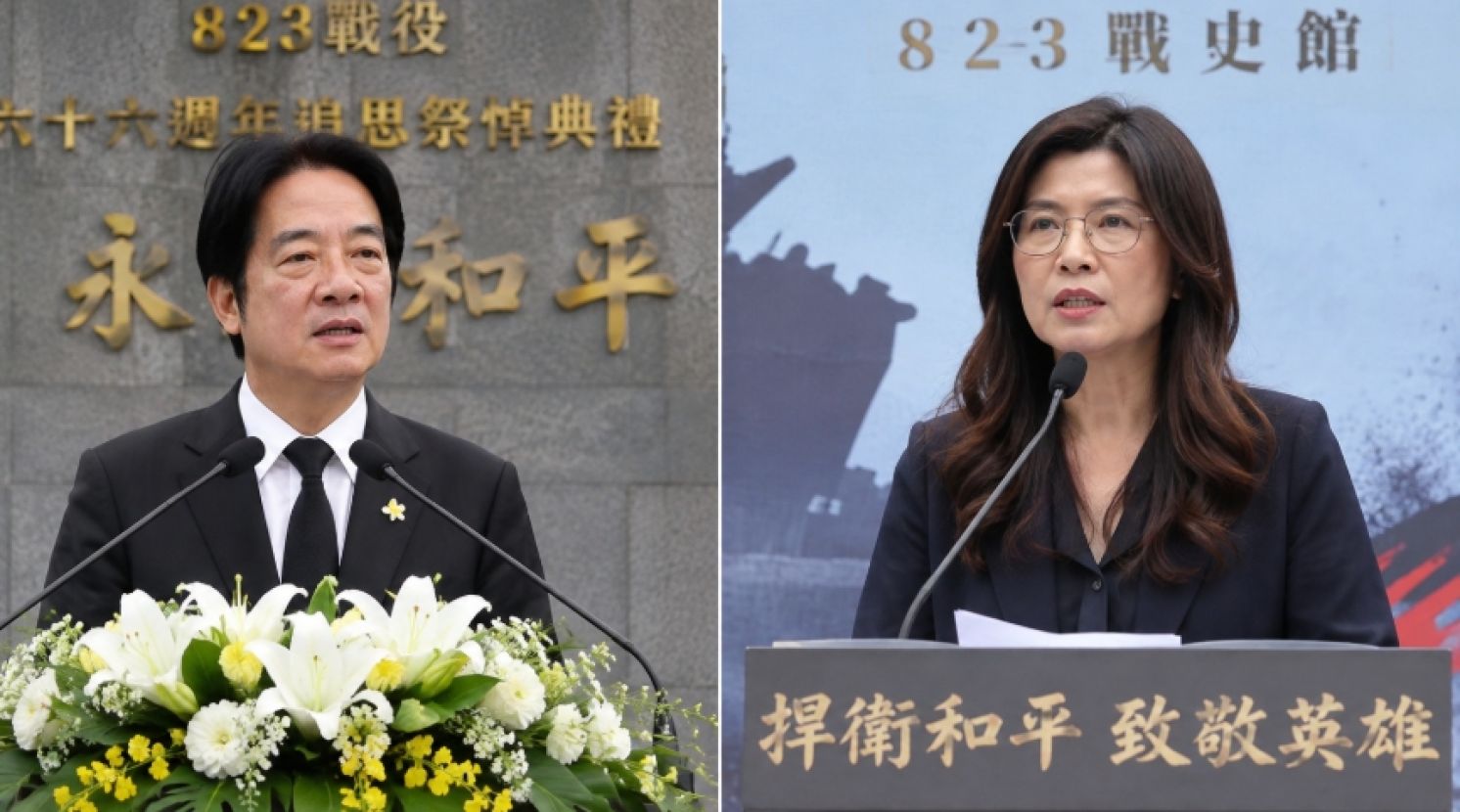
On the 68th anniversary of the August 23 Artillery Battle, President Lai Ching-te and Chairwoman Cheng Li-wun of the opposition Kuomintang (KMT) both traveled to Kinmen to commemorate the historic conflict, yet they presented sharply different narratives.
President Lai emphasized the old saying, “Even in times of peace, forgetting the possibility of war invites danger,” arguing that peace must be safeguarded through strong national defense. Chairwoman Cheng, by contrast, stressed the importance of cross-strait dialogue to prevent war, arguing that the responsibility of this generation is not to make the next generation repeat the sacrifices of the past but to reduce the risk of cross-strait conflict through dialogue, exchanges, and cooperation.
Both arguments claim peace as their ultimate goal, but they represent fundamentally different visions of how peace can be achieved. President Lai cited the outcome of the August 23 Artillery Battle as evidence that peace can be secured through strength. This argument is not entirely without merit. The soldiers and civilians of Kinmen did indeed hold the front line at enormous cost, and the conflict became an important turning point in the history of the Taiwan Strait.
However, reducing the lessons of August 23 to the idea that “as long as military strength is sufficient, peace will follow” is an oversimplification of history. The battle did not bring permanent peace across the Taiwan Strait. Its eventual cessation was not solely the result of military factors. What truly sustained peace in the Taiwan Strait was the political and strategic balance that emerged afterward.
Therefore, the warning that “forgetting war invites danger” may remind people not to take security for granted, but it should not be extended into the proposition that “preparing for war equals peace” or that “the more weapons we purchase, the safer we become.” If a country constantly views the other side with hostility and portrays cross-strait relations as a zero-sum relationship in which there can only be confrontation and no cooperation, military preparedness can easily evolve from a means of defense into a broader political mindset. In the end, even if neither side genuinely wants war, the risks of miscalculation, accidental clashes, and escalating crises may increase.
What is valuable about Ms. Cheng’s approach to peace is that she does not reject national defense; rather, she rejects war as a political option. She argues that peace is not naïveté but a responsibility that this generation cannot shirk. Resolving cross-strait differences through dialogue and exchanges is neither “surrender” nor an “abandonment of national security.” Instead, it expands the concept of security beyond military security to include political security, economic security, and the safety of people’s lives.
The cost of a single war could fundamentally alter the lives of millions of families. The question political leaders should therefore truly answer is: Can we prevent war from happening in the first place?
President Lai closely links the principle of “not yielding an inch of Taiwan, Penghu, Kinmen, or Matsu” with strengthening national defense, which risks placing cross-Strait relations in an increasingly confrontational framework. Defending national sovereignty is undoubtedly important, but military power is not the only means of protecting sovereignty. Political dialogue, cross-strait exchanges, economic and trade relations, and people-to-people interaction are equally important tools for reducing the risk of conflict. If every form of exchange is regarded as a risk and every dialogue as a concession, then military confrontation may eventually become the only option left.
President Lai’s confrontational approach is indeed moving toward a path of Taiwan independence—a path of no return that leads toward war. The path of peace represented by Chairwoman Cheng, by contrast, is what can prevent Taiwan from seeing the history of the August 23 Artillery Battle repeat itself. Sixty-eight years after the battle, Taiwan, Penghu, Kinmen, and Matsu must never again become battlefields. Instead, Kinmen should be transformed from a military front line into an outpost of peace. That would be the most meaningful transformation of history.
Peace has never simply fallen from the sky, but neither can peace be achieved only through war. To truly “preserve peace through strength” should mean steadily reducing the conditions under which war could occur. And the real danger in “forgetting war” lies above all in forgetting the terrible price that war exacts.