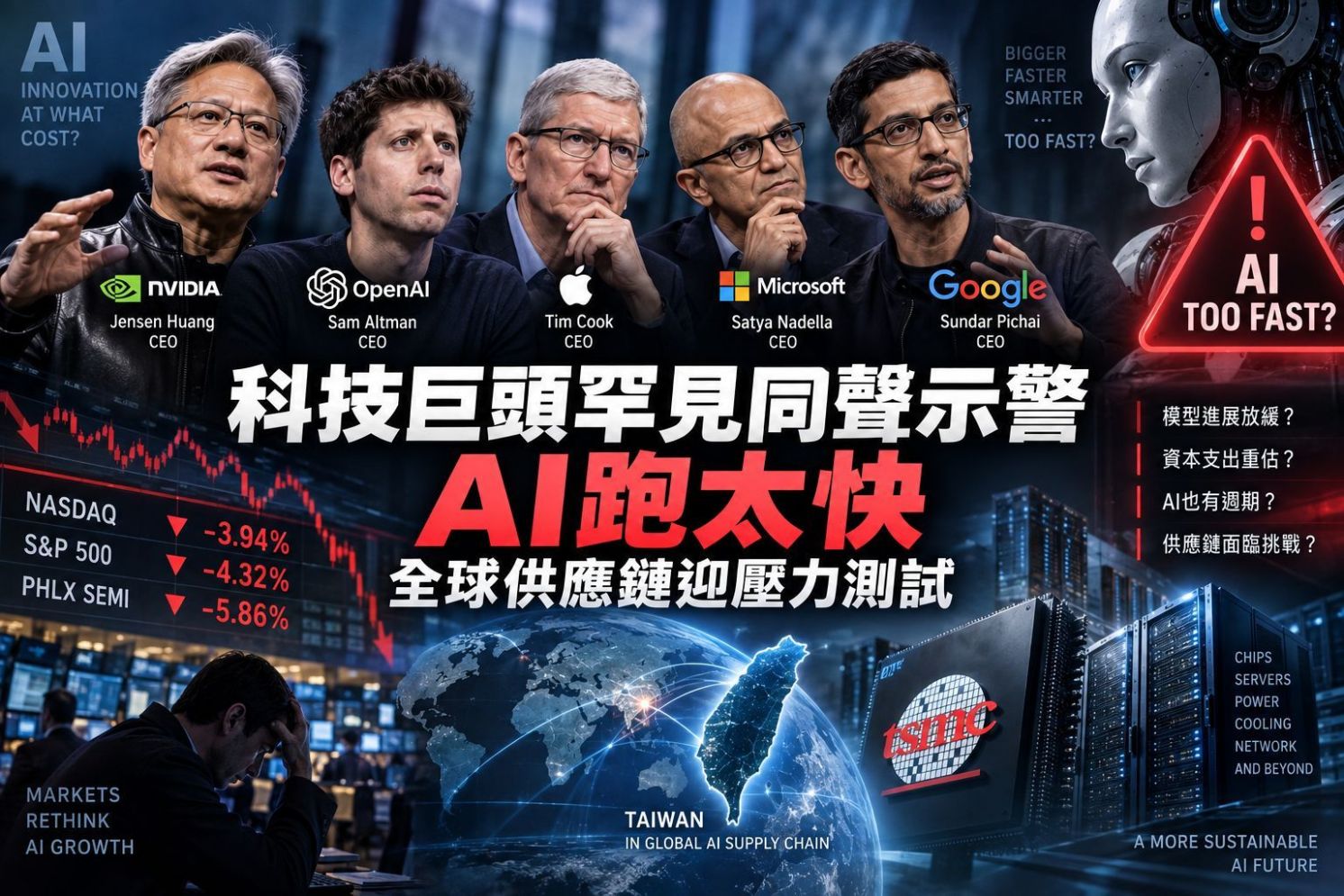
AI Giants Hit Brakes: Taiwan's Supply Chain Faces Stress Test
The Storm Media Commentary, September 17, 2026
Over the past two days, several of the people at the forefront of the race have, unusually, begun discussing the same question: Is artificial intelligence (AI) moving too fast?
The market quickly reacted. On September 14, AI and semiconductor stocks in the United States fell sharply, with chip stocks including Nvidia, AMD, and Marvell coming under pressure at the same time. The Philadelphia Semiconductor Index plunged 5.86 percent at the close. For the first time, Wall Street began trading on a scenario that few had been willing to imagine before: If AI models no longer evolve at their previous pace, then will the growth trajectory of trillions of dollars in AI capital expenditure also need to be recalculated?
OpenAI’s decision to postpone its 2026 initial public offering (IPO) cannot be explained solely by “safety.” The decision to go public also involves valuation, fundraising, market conditions, and shareholder arrangements. Nevertheless, safety governance has indeed introduced a new variable for capital markets.
Over the past two years, valuations across the AI supply chain have been built on a very simple logic: the larger the models, the greater the demand for graphics processing units (GPUs); the more GPUs there are, the more high bandwidth memory (HBM), chips-on-wafer-on-substrate (CoWoS), switches, servers, power supplies, cooling systems, and data centers expand accordingly. The market has almost treated this curve as a straight upward trajectory.
Now, for the first time, people are beginning to ask: If frontier models move from one generation every six months to one generation every year, could the construction of the next cluster containing 100,000 GPUs also be delayed?
This does not mean that AI demand is disappearing. But the market is beginning to acknowledge one thing: AI also has cycles, and training demand and inference demand do not necessarily move in sync. In addition, with U.S. long-term Treasury yields remaining high, the AI industry is facing two pressures at the same time: if expectations for future growth decline, the numerator in valuations becomes smaller; as the cost of capital rises, the discount rate also increases.
As a result, the market is shifting the question from “Is there demand for AI?” to “When will this demand materialize, how much capital will it require, and how long will it take to recover that investment?” This is the part of this round of volatility that is truly worth paying attention to.
For Taiwan, the issue is not simply whether fewer servers will be sold. Taiwan is positioned almost at the very front end of global AI capital expenditure.
The Taiwan Semiconductor Manufacturing Company (TSMC) manufactures GPUs and ASICs, while advanced packaging provides CoWoS and ASE handles testing and packaging. Hon Hai, Quanta, Wistron, and Wiwynn assemble servers; Delta Electronics provides power solutions; Auras and Sunonwealth handle cooling; Accton Technology makes switches; and the supply chain extends further into PCBs, CCLs, memory, optical communications, and heavy electrical equipment.
Therefore, the four more practical questions Taiwan should track going forward, beyond whether “AI orders are still there,” are: How many GPUs are needed? When will they be needed? Who will pay for them? And how much capital will suppliers have to advance upfront?
If the pace of model releases slows, then the first thing likely to be affected will be the construction schedule for the next generation of hyperscale training clusters.
For the supply chain, orders may remain, but the growth trajectory could change. Revenue may continue to increase, while inventory, accounts receivable, and financing needs could also rise at the same time. This is precisely where Taiwan’s AI super-cycle will face its first real stress test.
However, if an AI slowdown does occur, then capital expenditure may not simply decline; it could also be reallocated. Some capital may shift from Training to Inference, while another portion may move from simply purchasing computing power toward security, identity, and permission management.
In the future, AI infrastructure may evolve from:
Compute + Network
to:
Compute + Network + Security + Identity + Permission.
Hardware roots of trust, confidential computing, identity authentication, access control, AI cybersecurity monitoring, and agent governance could all become new forms of infrastructure as a result.
This also gives Taiwan a direction worth considering. If Taiwan continues to provide only chips, servers, and racks, then the added value will remain limited. If hardware, security, and enterprise know-how can be integrated, there may be an opportunity to move from being an AI equipment supplier toward becoming a trusted AI systems provider.