60% Support Taiwan's Taking Initiative on Cross-Strait Negotiations
China Times Report, April 23, 2026
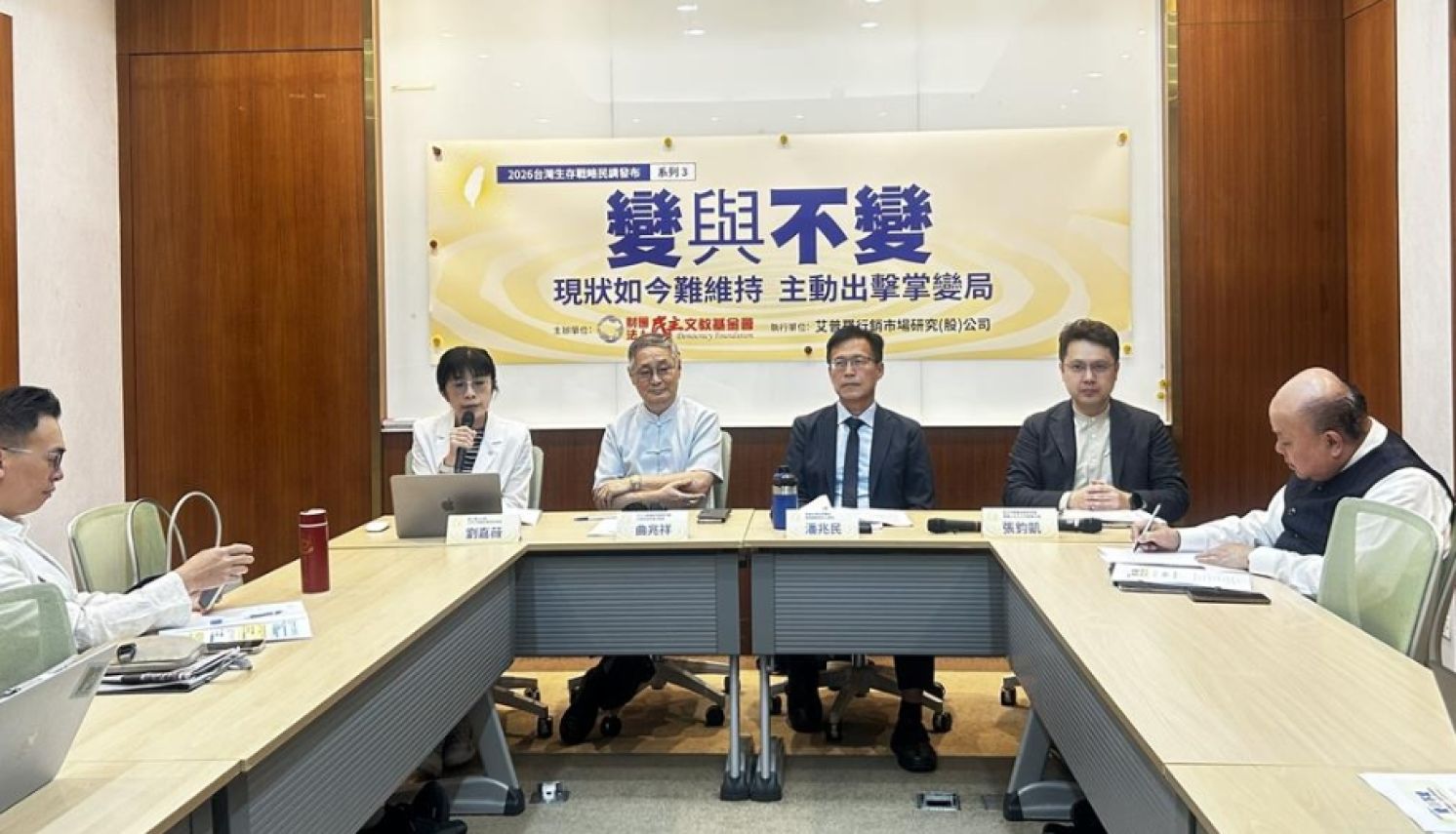
Amid a complex international environment and intensifying U.S.-China relations, what path should Taiwan take? On April 23, the Democracy Foundation held a press conference releasing the results of the latest public opinion poll on cross-strait relations. The poll shows that as many as 55.2 percent of respondents believe that Taiwan can no longer maintain the status quo; furthermore, 61 percent believe that rather than waiting for China to determine Taiwan’s fate, Taiwan should proactively engage in negotiations and propose “the most secure institutional arrangements.”
Foundation Chairman Kuei Hung-cheng indicated that President Lai once compared cross-strait unification to “a large company acquiring a small company,” and stated that “China is the larger company” and “it is not Taiwan that gets to set the conditions.” Therefore, the foundation boldly used the concept of “one country, two systems,” as proposed by the mainland for post-unification political arrangements, to cautiously conduct a preliminary exploration of Taiwanese public awareness, acceptance, and conditions regarding this concept. He also emphasized that the Taiwanese people should not be held hostage by Taiwan’s minority government.
According to the poll results, in response to the question, “Given the rapidly changing international situation, Taiwan can no longer maintain the ‘status quo’ and must choose between ‘change’ and ‘no change.’ Do you agree with this view?” 55.2 percent agree, 12.8 percent disagree, and 32 percent expressed no opinion or declined to answer.
In another question, “If it truly becomes impossible to maintain the status quo across the Taiwan Strait, are you more concerned about ‘losing your current way of life and rights’ or ‘a change in national name or designation’?” Some 67.4 percent choose the former, while 8.9 percent the latter, with 23.7 percent expressing no opinion or declining to answer. When asked which is more important, 64.2 percent prioritize the former, compared to 15.1 percent for the latter, with 20.6 percent expressing no opinion or declining to answer.
The poll also posed a hypothetical question: “If ‘personal freedom and property’ are guaranteed to remain unchanged, and quality of life improves, would adjusting the ‘national name’ be open for discussion?” Some 55.1 percent agree, 25.5 percent disagree, and 19 percent expressed no opinion or declined to answer.
For the question, “Whoever can ensure the safety and well-being of the Taiwanese people should be supported, regardless of past political positions—do you agree?” In response, 65.8 percent agree, while only 15.9 percent disagree. On whether Taiwan should proactively negotiate for “the most secure institutional arrangements,” 61.6 percent agree, compared to 21.9 percent who disagree.
Finally, regarding Taiwan’s future, when asked whether it should “do nothing and accept arrangements made by others” or “proactively negotiate to take control of our future development,” 70.5 percent support proactive participation, while only 4.6 percent oppose it.
Chu Chao-hsiang, a retired professor of the Graduate Institute of Political Science, National Taiwan Normal University, noted that 32 percent of respondents declined to answer the first question, indicating that one-third of the population are like “frogs in warm water” who have not yet felt the urgency. However, 68 percent (those who agree or disagree) have already formed an opinion, with 55.2 percent believing change is necessary, while 12.8 percent believe otherwise. Based on the disagreement data, this group represents those who firmly uphold Taiwan’s sovereignty, namely advocates of Taiwan independence.
Liu Chia-wei, professor at the Department of Public Administration and Policy at National Taipei University, analyzed that the poll clearly shows that at this critical juncture, the public is highly concerned about their livelihoods, particularly the “pocketbook economy.” Cross-analysis indicates that people aged 40 to 49 are especially concerned about losing their current way of life and rights, while those with a university education show the highest level of concern.
Professor Liu further stated that the poll clearly indicates that continued governance based on ideology not only risks losing public support but may also result in losing future opportunities to govern.
Pan Chao-min, professor at the Center for General Education, Tunghai University, added that among younger and middle-aged groups, the sentiment for change is particularly evident. Intensified U.S.-China competition has heightened uncertainty about the future, significantly increasing anxiety.
Vice Chairman Lee Sheng-feng of the New Party also attended the event and shared his views, stating that regardless of political affiliation, most politicians in Taiwan are “seriously disconnected” from the evolving public opinion and sentiment. Political power is transient in history; the people are the true protagonists. Political regimes are merely a shell, while the people are the soul.
From: https://www.chinatimes.com/realtimenews/20260423002262-260407?chdtv